At a glance
Peaches are one of the most rewarding fruits a UK garden can produce. Fan-trained against a south-facing wall, a mature tree in mid-August carries large, fragrant fruit of a quality that commercially grown peaches cannot match – the flavour of a tree-ripened peach is altogether different from anything in a supermarket. The wall provides reflected heat, protection from cold winds and the frost shelter that makes reliable cropping possible in Britain, where the blossom opens in March. All peach varieties are self-fertile, so a single tree is sufficient.
The central task in peach growing in the UK is managing peach leaf curl, a fungal disease that spreads through rain onto the developing buds in late winter and early spring. The solution is straightforward – keep rain off the tree from November until mid-May with a polythene or fleece lean-to shelter – and once this is in place, the remaining management is seasonal pruning and routine care. With a suitable wall and the rain shelter habit established, peaches are genuinely within reach of any UK gardener.
Best varieties for UK gardens
Peregrine is the most widely grown outdoor peach in the UK and has been since its discovery in 1906. It carries white flesh with exceptional flavour and ripens from mid-August. Rochester is yellow-fleshed, flowers later than most varieties which helps it avoid late frosts, and is the most reliable choice for northern England and the Midlands. Avalon Pride is the most disease-resistant variety available, showing notable tolerance to peach leaf curl and earlier to ripen than either Peregrine or Rochester. Bonanza is a compact dwarf variety bred for container growing, producing full-sized fruit on a plant that stays under 1.5m and can be moved under cover in winter.
Position and planting
A south or south-west facing wall is the correct position for peaches in all but the warmest parts of England. The wall does two things that make reliable cropping possible: it reflects heat from the stored warmth in the masonry and protects the tree from cold north and east winds that can damage both blossom in March and developing fruit in early summer. A south-west aspect is often preferable to due south because it receives afternoon and evening sun rather than the sharpest morning warmth, and in many gardens provides better shelter from prevailing westerly winds. North-facing walls should never be used for peaches.
Fix horizontal training wires at 30cm intervals up the full height of the wall before planting. Vine eyes and galvanised wire are the standard approach – the wires must be in place before the tree goes in, as retrofitting around an established fan is far harder. Soil should be well-drained and fertile, with a pH between 6.0 and 6.5. Outside this range nutrient uptake becomes impaired regardless of how much fertiliser is applied – a simple soil test before planting is worthwhile if your soil is unknown. Avoid planting on ground where a peach, nectarine, cherry or plum has grown before, as replant disease caused by microscopic soil organisms can severely check establishment. If replanting on the same spot cannot be avoided, replace the soil in the planting hole with fresh compost and topsoil brought from another part of the garden.
Plant between November and March when the tree is dormant. Most UK nurseries supply peaches on St Julien A rootstock, which is semi-vigorous and well-suited to fan training – it produces a manageable tree that will eventually cover 3-4m of wall. Brompton is a more vigorous rootstock sometimes encountered; avoid it for wall training as the resulting tree will quickly outgrow its space and become unmanageable. Plant the tree 20-30cm from the wall base so the roots are not in the driest ground, angle the stem back toward the wall, and ensure the graft union – the swollen joint between rootstock and scion – sits slightly above soil level. Firm well, water thoroughly, and tie the initial shoots loosely to the training wires.
For containers, choose Bonanza or another compact variety and use a pot at least 45cm wide and deep filled with a soil-based compost such as John Innes No. 3. Soil-based mixes hold moisture and nutrients better than lightweight peat-free alternatives and are heavy enough to keep the pot stable. Container trees can be moved under cover – a cold greenhouse, unheated porch or conservatory – from November to April, which eliminates leaf curl risk entirely for potted trees and gives the blossom better frost protection.
Hand-pollinate for a better crop. Peaches flower in March when pollinating insects are scarce. On a dry, still day when flowers are fully open, run a soft dry paintbrush gently over each open flower in turn. This transfers pollen between flowers and significantly improves fruit set on sheltered wall-trained trees where insect access is limited.
Fan training – year by year
Fan training creates a flat, symmetrical framework of branches radiating from a short main stem, all tied to horizontal wires spaced 30cm apart up the wall. The goal is to fill the wall space evenly, maximise exposure to reflected warmth, and keep the structure open enough for air to circulate freely. A completed fan should cover at least 2.5m wide and 2m high. The framework is established over the first two to three years from a young maiden tree; full productivity follows in years three to four. Start with a one or two year old maiden rather than a mature specimen – young trees train far more readily and the framework develops cleanly from the beginning.
In year one, after planting, select two well-placed lateral shoots growing roughly 30-45cm from the ground – one on each side – and tie them at 40 degrees to canes fixed to the wires. Cut the central leader just above these two shoots and remove all other laterals flush with the main stem. These two angled arms become the permanent basis of the fan. In year two, allow three or four shoots to develop evenly along each arm and tie them into the fan at angles that spread the branches to fill the wall space. Remove any shoots growing straight out from the wall or directly back against it. The fan shape should begin to be visible by autumn of the second season. In year three, continue extending the framework by selecting shoots to fill remaining gaps, and the tree should carry its first modest crop. From year four, switch entirely to the annual renewal cycle described below.
Annual pruning cycle
Peaches fruit on shoots produced the previous year. Once the fan framework is established, the annual goal is the same every season: allow replacement shoots to develop at the base of each fruiting shoot during the growing season, remove the old fruited wood after harvest, and tie the replacements into the fan in its place. This systematic renewal prevents the build-up of old unproductive wood and keeps the tree fruiting at the tips of young shoots. All pruning – both the spring rubbing-out of misplaced shoots and the post-harvest removal of fruited wood – must be done between late March and August. Never prune in autumn or winter, when silver leaf fungus (Chondrostereum purpureum) enters through fresh cuts most easily.
Disease and pest management
Peach leaf curl is the most significant disease challenge for UK peach growers. The fungus Taphrina deformans overwinters on bark and in bud scales, and spreads through rain splashing spores onto the swelling buds between autumn and late spring. Infected leaves blister, pucker and turn red before dropping prematurely. A badly infected tree can lose most of its foliage by midsummer, which severely weakens it and significantly reduces the following year’s crop. Once leaves are fully open the infection window closes, but by then the damage is already done – there is no spray treatment that will cure infected leaves.
The single most effective prevention is a rain shelter fitted over the wall-trained tree from after leaf fall in November and kept in place until mid-May. The shelter should cover the top of the tree and the front face down to within 30cm of the ground, with both sides open to allow air circulation and access for pollinating insects when the blossom opens. Polythene or polycarbonate sheeting fixed to a timber frame on vine eyes works well, or horticultural fleece stretched over a simple frame. Once leaves have fully opened in mid-May, remove the shelter entirely so summer growth proceeds in full sun and air. Any infected leaves that do appear – recognised by red blistering – should be removed and binned immediately. Never compost them.
Brown rot prevention centres on good fruit hygiene and consistent watering – irregular dry then wet conditions cause skin cracking which lets the fungus in. Remove affected fruit immediately and never leave mummified fruit on the tree over winter. For silver leaf, the entire prevention is staying within the pruning window: late March to August only. If a branch is suspected of silver leaf, cut it back until the brown staining in the wood disappears and sterilise your secateurs between cuts. Frost protection for blossom in March is simply a double layer of horticultural fleece draped over the tree on nights when frost is forecast, removed each morning to allow pollination. A wall-trained tree is well-suited to this because the wall itself provides some thermal mass and the fleece is easy to hang from the wires.
Care, feeding and harvesting
Feed peaches in late February with a balanced general fertiliser worked into the soil around the base. From early June, switch to a high-potassium feed applied every two weeks until the fruit has been harvested – potassium drives fruit sweetness and swelling and is the most important nutrient through the fruiting period. Avoid high-nitrogen feeds after midsummer as they produce soft, sappy growth that is prone to disease and less likely to ripen properly before winter.
Watering through the fruiting period is critical. From June until harvest, water deeply twice a week rather than lightly every day – deep watering encourages roots to go down where they are more buffered from surface drought and heat. Irregular watering – long dry spells followed by heavy rain or irrigation – causes fruit skins to split as the internal pressure changes faster than the skin can accommodate. Split skin lets brown rot in and ruins the crop. Mulch the root zone each spring with well-rotted compost or manure, keeping the material clear of the main stem. The mulch conserves moisture through summer, suppresses weeds and feeds the soil slowly.
Fruit thinning in June is important for crop quality. After the natural June drop, when the tree sheds its own smallest fruitlets, thin the remainder to one per 15cm. Remove the smallest and any misshapen fruit first. Without thinning, the sheer number of fruits means none achieve proper size or sweetness in the UK’s shorter, cooler summer – twelve full-sized peaches from a tree is a better result than forty small, flavourless ones. Container-grown trees need particular attention to thinning as the restricted root system limits how much fruit the tree can support to full ripeness.
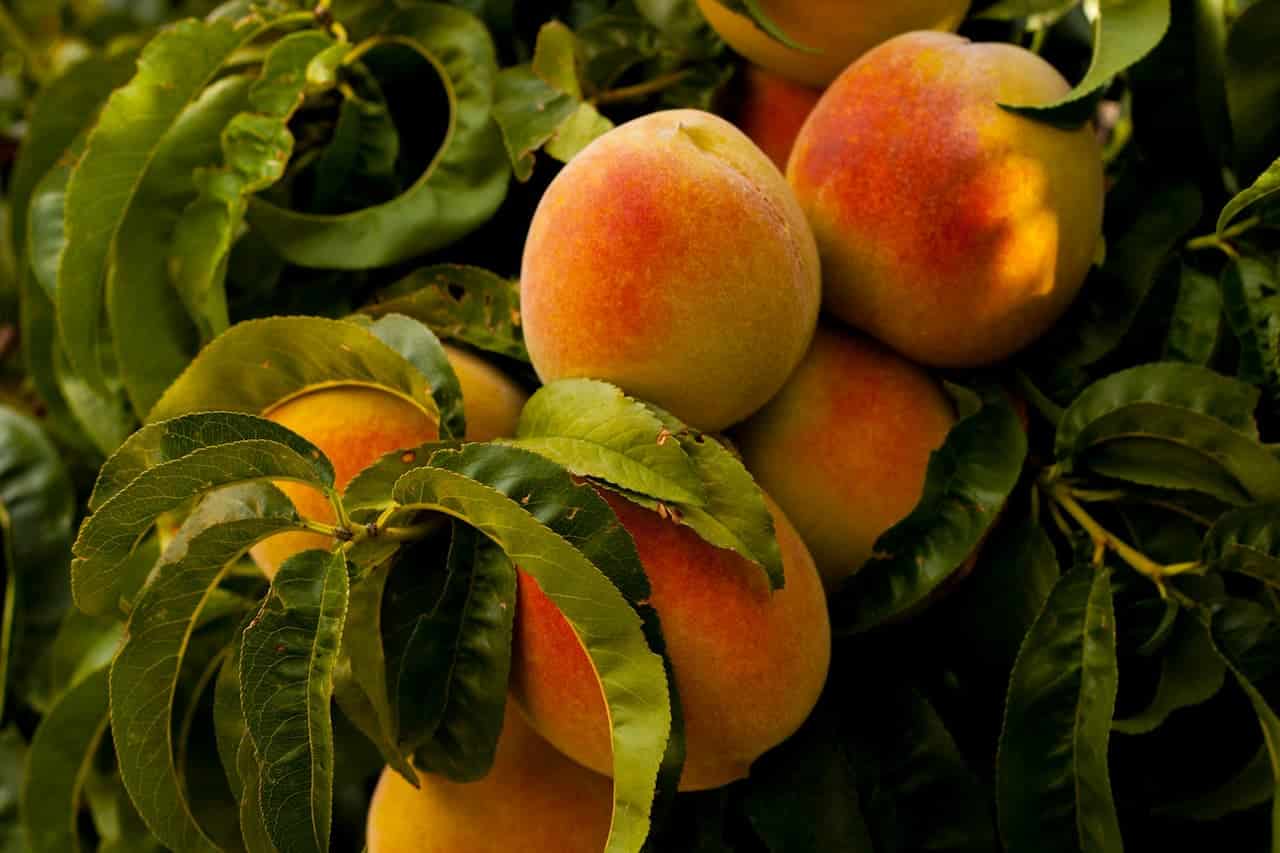
Peaches are ready to harvest when the flesh near the stalk gives slightly to gentle thumb pressure and the fruit lifts away from the branch with a slight upward twist. Do not pull directly downward or the skin tears. A ripe Peregrine will have a deep cream-white background colour flushed with crimson. Eat within two to three days of picking, or store in a cool place for up to five days. For surplus fruit, halving and stoning then freezing on a tray before bagging preserves the flavour well. Frozen peach flesh works in crumbles, smoothies and jam throughout winter. A tree-ripened Peregrine harvested in mid-August – warm from the wall, juice running at the first bite – is one of the finest things a British garden can produce.
Never use old creosote-treated sleepers or timbers near peaches or any edible crop. Creosote is classified as a hazardous substance in the UK and is no longer legal for garden use. For raised beds or retaining walls near the tree, use untreated or pressure-treated timber rated for ground contact only.
Share on socials: