At a glance
Block paving is one of the most durable, attractive and practical hard landscaping surfaces available for UK driveways, paths and patios. Individual concrete or clay blocks interlock to create a flexible surface that can handle vehicle loads, accommodates minor ground movement without cracking, and can be lifted and re-laid if access to drainage or utilities below is ever needed. Unlike poured concrete, which cracks as the ground shifts and must be replaced in large sections, block paving distributes movement across the joints between individual units and can be repaired selectively by lifting and re-laying just the affected blocks. Done properly with an adequate sub-base and correctly installed edge restraints, block paving lasts decades with minimal maintenance and improves the appearance and value of a property significantly.
The job is well within reach of a competent DIY enthusiast for smaller areas – paths, patios and small parking areas up to around 20 square metres. Larger driveways, particularly those subject to heavy vehicle use, are better handled by a professional installer with access to a plate compactor and the experience to achieve consistent sub-base depth and level across a large area – both of which are more demanding than they appear. This guide covers the complete process for both the DIY and contractor routes, with particular attention to the base preparation stages that ultimately determine whether block paving lasts five years or fifty.
What you’ll need
Choosing your blocks
Standard concrete block paving is the most widely used and cost-effective option for UK driveways and paths. The standard size is 200 x 100 x 65mm for driveways (this thickness is specified for vehicular use) and 200 x 100 x 50mm for paths and patios that will not carry vehicle loads. Thinner blocks on a driveway will crack under vehicle weight even with a good sub-base – always use 65mm blocks where cars will park or drive. Clay block paving is more expensive but offers richer natural colour, better weathering characteristics and longer-term fade resistance compared to concrete. It is preferred for period properties, conservation areas and situations where the warmer tones of clay will complement existing brickwork better than the cooler appearance of concrete. Permeable block paving has become increasingly popular since UK planning regulations changed in 2008, as it is exempt from permitted development restrictions for front garden driveways – a significant practical advantage for many homeowners.
Front garden driveways require planning permission if the surface is non-permeable and over 5m2. Permitted development rights for front garden paving were tightened in 2008. Non-permeable surfaces – including standard concrete and clay block paving – require planning permission for new or replacement driveways in England if the area exceeds 5m2. Permeable block paving avoids this requirement entirely. Check the gov.uk planning permission guidance or your local planning authority before starting work on a front garden driveway.
Preparing the base
Base preparation is by a considerable margin the most critical stage of block paving installation, and it is the stage most commonly skimped on in cheaper contractor installations and DIY projects alike. A block paving surface is only as good as the sub-base beneath it – blocks laid on insufficient or poorly consolidated sub-base will sink, rock and begin to displace within a few years regardless of the quality of the blocks or the skill of the laying, neither of which can compensate for an inadequate base. The sub-base depth required depends on the intended load: for paths and patios a minimum of 100mm compacted MOT Type 1 (crushed limestone aggregate) is required; for driveways subject to regular car use the minimum is 150mm, and for heavier vehicles 200mm or more.
The sub-base must be laid and compacted in layers no deeper than 100mm per pass using the plate compactor. Trying to compact a 200mm layer in a single pass produces only surface consolidation – the material below remains loose and will settle over time. After compaction, check the level across the sub-base with a long straight-edge and fill any low spots before adding the sand bed. The finished sub-base should have the same fall direction and gradient as the intended finished surface – typically a minimum 1:60 fall away from buildings to ensure surface water drains correctly. Where the paving abuts a building, check that the finished surface level will be at least 150mm below any damp proof course to comply with building regulations and avoid moisture bridging into the wall. This measurement is worth checking and recording before the sand bed goes down, as it is much harder to correct once the blocks are laid.
Laying the blocks
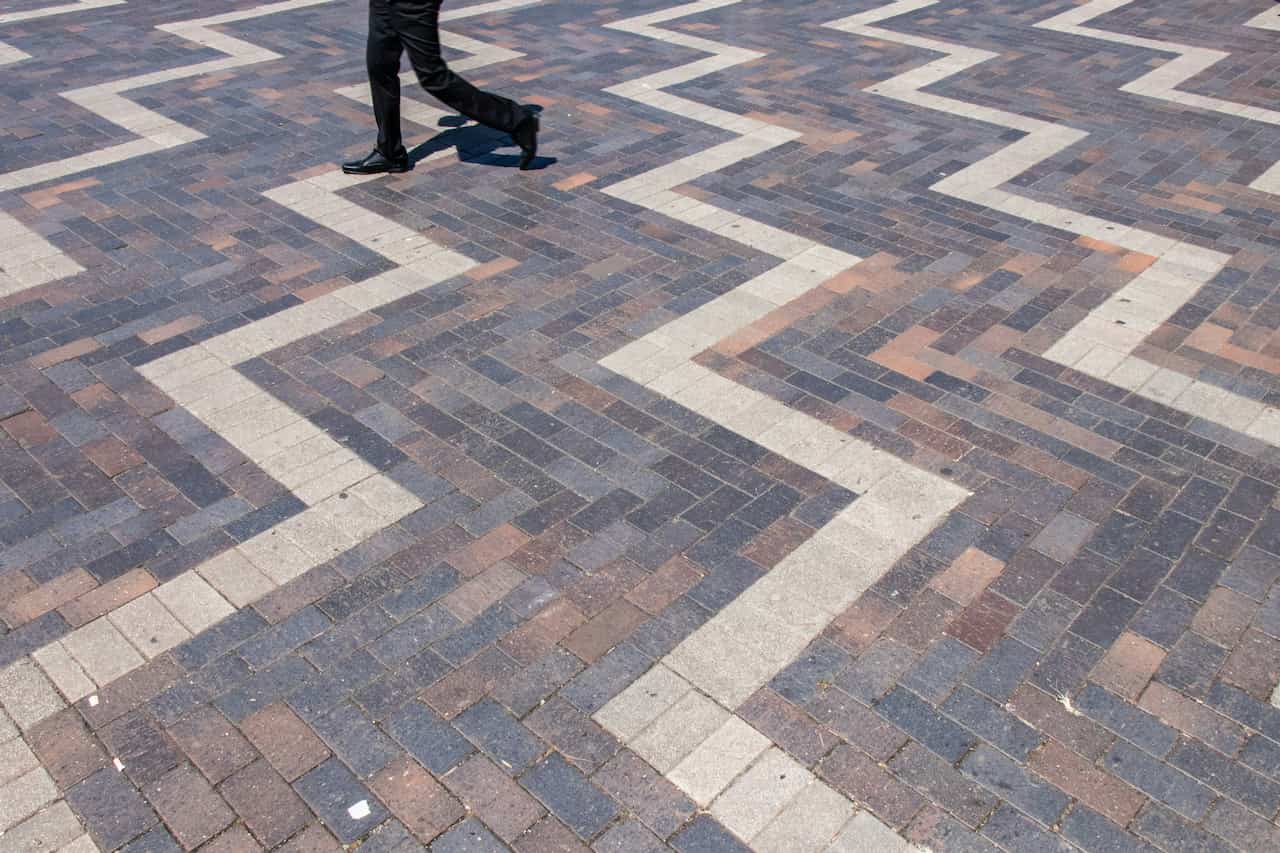
Once the sub-base is compacted and the 40-50mm sand bed has been screeded to a consistent depth and the correct fall, block laying can begin. Start from a corner or a straight line – typically along a wall, building edge or kerb – and work outwards. Lay blocks with tight joints (3-5mm maximum) in the chosen pattern: herringbone at 45 or 90 degrees, basket weave, or stretcher bond are the most common. Herringbone at 45 degrees is the strongest pattern for driveways as it interlocks in two directions and distributes load most effectively; stretcher bond is more economical to lay but provides less interlock.
Do not walk on the screeded sand before blocks are laid – footprints compress isolated areas of the sand bed and produce an uneven surface that shows as visible bumps and dips after the final compaction stage. Use a kneeling board placed on the laid blocks to work from as you progress. Set each block by placing it vertically then lowering it into position – do not slide blocks across the sand bed. Tap each block firmly into the sand with two or three blows from the rubber mallet to set it just fractionally above the level of adjacent blocks; the plate compactor will bring the entire surface to final level. Cut blocks as needed for edges, curves and features using the angle grinder or block splitter, keeping cut edges to the perimeter where possible. Once all blocks are laid and cut, run the plate compactor across the entire surface twice to drive blocks firmly into the sand bed and achieve the final level. Brush kiln-dried jointing sand across the surface and make two more passes with the compactor to work it into the joints. Repeat until joints are filled to within 3mm of the surface. The pavement can be used immediately after jointing is complete.
Costs and planning
Block paving costs vary considerably depending on block type, site conditions and whether the work is DIY or contractor-installed. The material cost for standard concrete blocks is typically £12-18 per m2; laying by a contractor adds £40-60 per m2 for labour and plant hire, bringing the total to £52-80 per m2 fitted. Clay blocks or premium decorative concrete increase the material cost to £25-45 per m2. A typical double driveway of 40m2 in standard concrete block paving costs £2,000-3,500 if professionally installed, though prices vary significantly by region – London and the South East are typically 20-30% higher than the national average. Getting three quotes from BPMA (Block Paving Manufacturers Association) accredited contractors provides a reliable market rate and ensures the specification matches what will actually be installed.
Block paving on a front garden driveway may require planning permission depending on the surface type and area involved – permeable block paving avoids this requirement and is generally the recommended choice for new front garden driveways under current UK regulations. If the project involves changing levels or drainage routes near a garden steps or boundary features, consider how surface water will flow before finalising the layout. For projects near existing garden walls or structures, check that the finished paving level will not bridge any damp proof courses in adjacent brickwork. The completed surface can be sealed with a block paving sealant to lock jointing sand in place, enhance colour and reduce weed growth – this is optional but extends the maintenance-free period considerably before re-jointing is needed.
Share on socials: