At a glance
I’ve got enough Ryobi 18V batteries knocking about the shed already that when I needed a cordless pressure washer, picking one that shared the same battery system was the only sensible option. The RY18PWX41A-0 was the one that made sense, not because it’s the cheapest in their range, but because it claims real pressure rather than just a stronger hose.
Three power settings, 7, 22 and 41 bar, a brushless motor, and 2.4kg once the battery’s in. The question was whether 41 bar from something this small actually means anything in practice, or whether the number on the box is doing more work than the machine is.
Overview and first impressions
Setup is genuinely just connecting the hose and clicking the two-part lance and nozzle together, a couple of minutes at most. Charging the battery takes longer than putting the whole thing together.
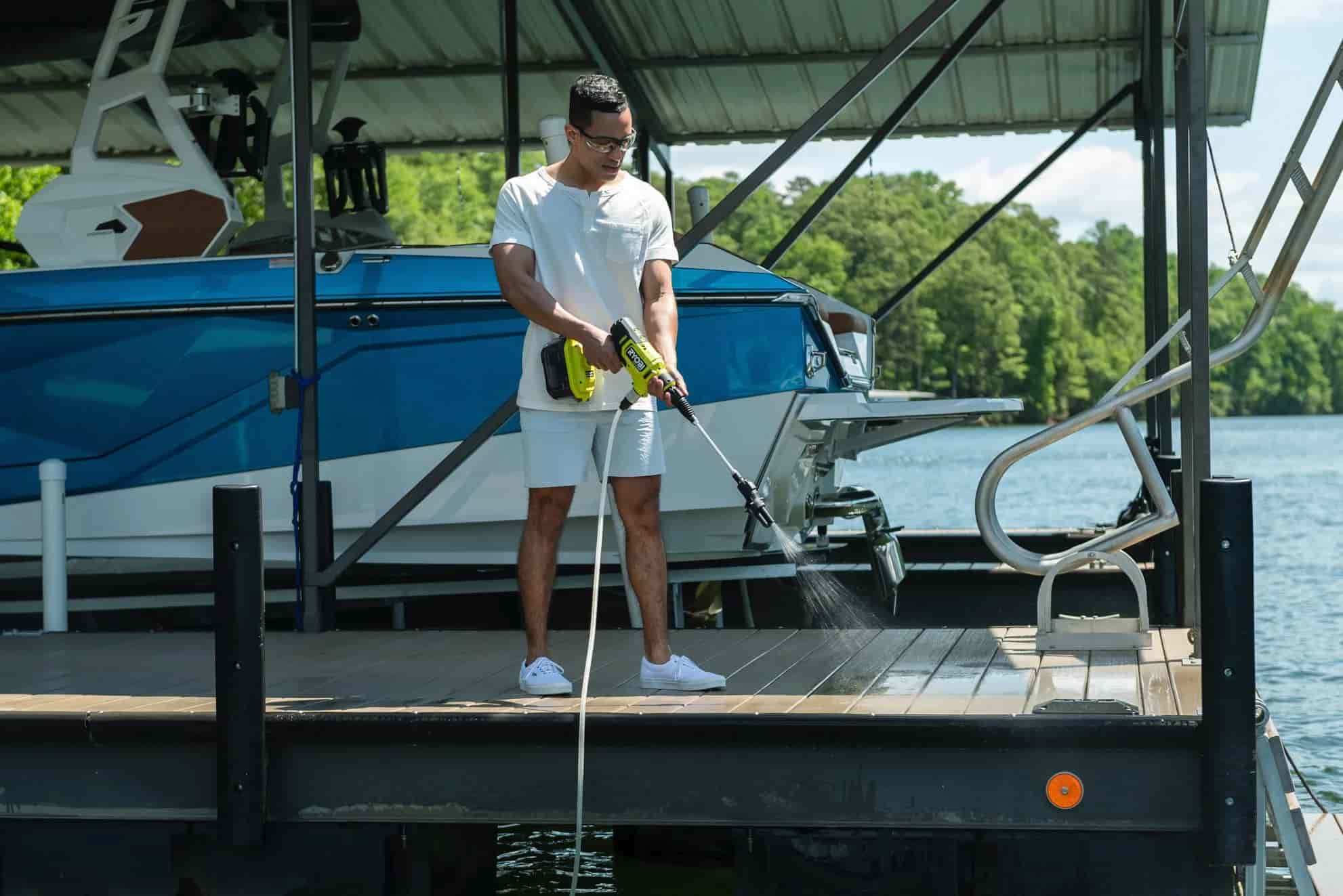
It’s built like a tool rather than an appliance, a proper trigger grip with a lock button so it can’t fire by accident in the boot of the car, and a membrane button on the rear that steps through the three power settings. The nozzle itself rotates between a 15° fan spray, a rinse pattern and a more aggressive turbo setting, so between the button and the nozzle you’ve effectively got fine control without ever swapping an attachment.
At 2.4kg it’s heavier than the lightest cordless options out there, enough that you notice it in one hand after a few minutes, but it never felt like a strain for the length of a typical job.
Give it thirty seconds after refilling your water source. The spray drops to a weak spritz the moment your bucket or bottle runs dry, and it takes a good half a minute of squeezing the trigger after refilling before the six metre pipe has drawn water all the way through again and you’re back to full pressure.
Specifications and scores
How it performed in our tests
The car was the easy win. Loose mud from the wheel arches and general road grime came off quickly on the 22 bar setting, with the turbo nozzle pattern doing the heavy lifting on the wheels themselves. The rinse setting earned its place straight after, washing the snow foam off cleanly without blasting it back onto panels I’d already done. It’s genuinely satisfying to use, enough bite that you can feel it working rather than just rinsing.
The bike got the same treatment a few days later, mud worked into the frame and chain after a wet ride. The 15° fan spray lifted the worst of it without needing to get the turbo setting anywhere near moving parts, and the float on the end of the hose meant it sat properly in the bottom of a half-filled bucket rather than sucking air the moment the water level dropped.
Paving on the 41 bar setting lifted general dirt and moss well, though I had to go over a couple of patches twice where the grime had really baked in over a dry summer. It’s not slow exactly, but it asks for a more deliberate, methodical pass than a mains machine would.
Decking was where I had to back off. The turbo setting raised the grain almost immediately on an old, untreated section, so I dropped to the fan spray on 22 bar instead, which cleaned it up without doing any damage, just more gently than I’d have liked given the time it took.
Test the turbo setting on a hidden patch of decking first. It raises the grain on older, untreated boards faster than you’d expect. The fan spray on the middle power setting is gentler and still does the job, just with a bit more patience.
Battery system and runtime
This runs on Ryobi’s 18V ONE+ platform, so if you’re already invested in their drills, saws or anything else in the range, this draws from a battery you might already own rather than forcing a new one on you. Ryobi’s own claim is around 29 minutes from a 4.0Ah battery.
In practice, the battery was never what ran out first. I tried running it from a 10 litre watering can as a makeshift tank and got just over four minutes before it started sputtering, with the 2-litre bottle adapter genuinely only good for 20 to 30 seconds of spraying before it’s dry. The real limiting factor here is how much water you can bring with you, not how much charge is in the battery.
Performance and limitations
What stands out here is that 41 bar genuinely feels like 41 bar. Cars, paving and general garden grime all came up properly, and the three power settings combined with the rotating nozzle mean you’ve got a real range to work with rather than one fixed strength trying to do everything.
The limitation isn’t really the machine, it’s the format. Bring-your-own-water cordless washers will always be capped by how much you can carry, and this is no exception, you’ll be refilling a bucket more often than you’d like on anything bigger than a single car or a small patch of paving. Baked-on mud, dried cement and old paint splodges are also genuinely beyond it, and it’s worth being realistic that nothing in this cordless, bring-your-own-water format gets close to what a full-size mains pressure washer can do on the toughest jobs.
The thirty second wait after every refill is a small thing that adds up over a longer job. It’s not a fault, just the reality of drawing water through six metres of pipe each time, but it’s worth knowing about before you’re stood there wondering why nothing’s coming out.
- 41 bar genuinely feels like real pressure
- Shares a battery with the wider Ryobi 18V range
- Trigger lock prevents accidental firing
- Three real power settings, not just one fixed strength
- Water supply runs out long before the battery
- Thirty second wait to re-prime after every refill
- Heavier than the lightest cordless options
- No real answer for baked-on mud, dried cement or paint
- Existing Ryobi 18V ONE+ owners
- Anyone who wants genuine pressure in a portable format
- Cars, bikes and small patches of paving
- Anyone without a convenient water supply nearby
- Anyone dealing with baked-on mud or dried cement regularly
- Anyone wanting the lightest possible handheld option
Final verdict
This earns its place through being genuinely capable rather than just genuinely portable. The 41 bar setting isn’t a number for the box, it does real work on paving and general garden grime, and the three-setting system means it’s just as happy being gentle on the car or decking when that’s what’s needed.
The real thing to plan around isn’t the battery, it’s the water. Bring a proper bucket or container rather than relying on the bottle adapter for anything beyond the lightest job, and budget for that thirty second wait every time you refill.
If you’re already on Ryobi’s 18V platform, this is an easy recommendation. If you’re starting from nothing, it’s still a genuinely good cordless washer, just don’t expect the battery system to be the deciding factor either way, the water supply will make that decision for you first.
A genuinely capable cordless washer where the pressure is real rather than nominal. Held back not by the battery but by how much water you can realistically bring with you, and by a recurring wait every time you refill.
Share on socials: