At a glance
Ran a stack of almost twelve inch wide plywood through the Milwaukee M18 FMS190 down into repeat pieces, and the 190mm blade never quite reached all the way across in one pass. Score the top, plunge through the near side, slide the head back, then flip the whole board and finish the strip the blade missed the first time. Fourteen cuts like that in a row, same routine every time, and it never once felt like fighting the saw, just working around what a blade this size was always going to run short of on stock that wide.
That gap between the capacity table and what happens on a wide board is worth knowing before it catches anyone out mid job. The square, zero degree figure looks generous on paper. Push toward the edge of it on real material and the plunge and flip becomes the normal way of working rather than an occasional trick.
Overview and first impressions
The same kind of cutting, pushed hard and repeated over and over on thick stock, is also where the one real weak spot in this saw’s history shows up. A saw that had worked reliably for months, deep into a run of exactly that plunge and flip work, bogged down mid cut and stopped dead. No burning smell, no obvious pinch, nothing dramatic. Batteries checked out fine across three different packs tried in turn. The eventual diagnosis, weeks later, came back vague: bad electronics, no single cause pinned down. The repair itself dragged on for the best part of a month, and the tracking chip fitted to the tool was separately marked lost by whoever was meant to be keeping tabs on it during that stretch, which says nothing about the saw’s own reliability but says plenty about the experience of getting it back. Worth being straight about that rather than only reporting the reliable years of ownership that are far more typical. One real, specific failure happened. It followed genuinely demanding, repeated use rather than routine cutting, and the repair process was slow and imperfect when it happened.
Check squareness on delivery. Some units pick up play in the sliding rail that lets the arm sit slightly off square when the head is drawn forward, enough to throw a mitre out of true. Milwaukee builds a correction screw into the saw specifically for truing the guide plate back to 90 degrees against the blade. Rack the slide fully out and test a square cut before trusting the saw with a batch of identical mitres, and know where that screw is if it needs it.
Specifications and scores
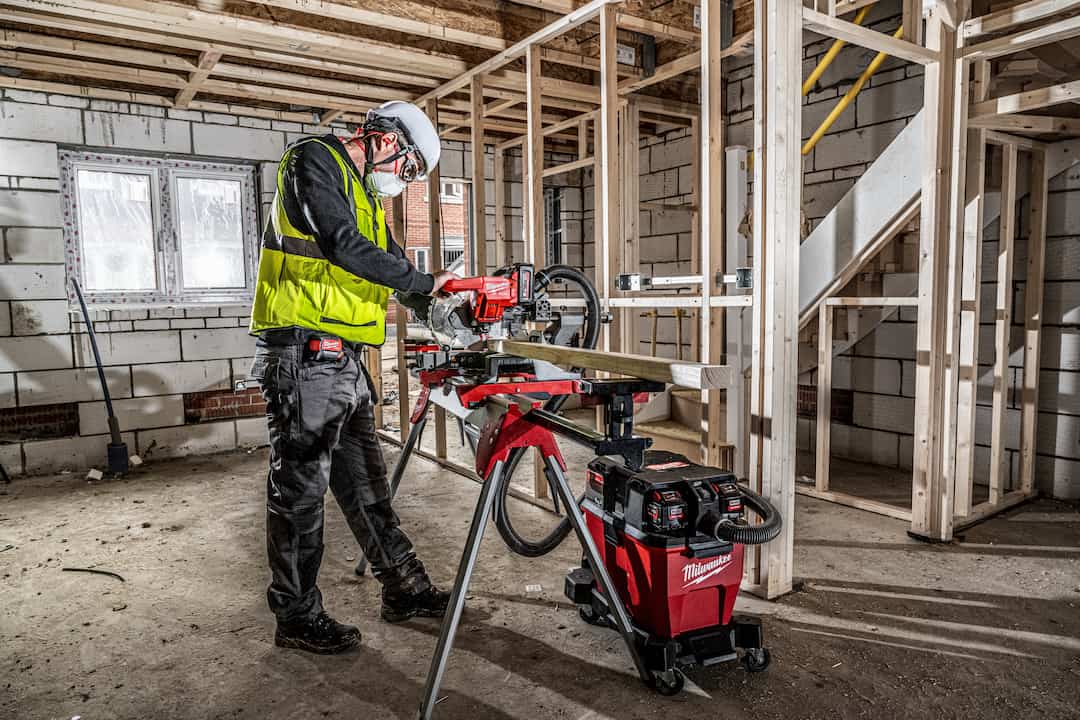
Full specifications, taken from the machine’s own rating plate and the official spec sheet: blade diameter 190mm, bore 30mm, no load speed 5,000rpm. Cutting capacity at the fence, square, is 90.9 x 21.8mm, rising to a maximum crosscut of 215.5 x 55.4mm at full mitre and bevel combined. Noise runs to 88.9dB(A) sound pressure and 99.9dB(A) sound power, worth ear defenders on anything beyond a handful of cuts. Net weight is 12.7kg with a battery fitted, light enough that more than one listing independently calls it the lightest saw in its class at that weight. Large sliding fences support the material through the cut, and the saw mounts onto any Milwaukee mitre saw bench or stand rather than needing a dedicated one.
Bevel is a genuine 48 degrees both left and right, a real practical difference from saws in this bracket that only give a working range on one side and treat the other as a token correction. What most listings quote is the square, zero angle capacity, and that hides something worth knowing: the maximum crosscut at a 45 degree mitre is not perfectly identical left to right, 90.9 x 20.3mm one way against 90.9 x 17.8mm the other. Tilted one way the fence supports a touch more material than tilted the other, which comes from how a single sliding arm mechanism works rather than a fully mirrored dual setup, and it only matters on a cut already pushing the saw’s outer limit in that direction. Still worth knowing the headline angle figures are symmetric even though the real capacity behind them is not quite.
How it performed in our tests
Three named systems get listed on a spec sheet as though they are three separate features, and they are not. Powerstate is the brushless motor itself, built for a longer working life and more power per charge than the brushed motor it replaced. RedLithium is the battery pack technology, standard across every tool in the range regardless of what it is bolted to. RedLink Plus sits between the two, watching load in both directions and adjusting rather than simply cutting power the moment something gets close to a limit. Pushed deliberately past its rated capacity, specifically to see whether it would stall, the saw pulled through anyway, and that is Powerstate and RedLink Plus working as a pair rather than either one on its own earning the credit.
Plan for the depth limit before starting. On stock wider than the saw’s single-pass capacity, score the top, plunge the near side, then flip the board to finish the far strip. Knowing this before starting a run of wide cuts beats discovering it mid job.
Grip and controls only really show themselves once the saw is being used rather than read off a spec sheet. The D-handle with its rubber over mould feels closer to a drill grip than the plain vertical trigger handle most mitre saws use. The safety switch is a small flip lever built into the trigger itself rather than a separate button somewhere else on the housing, and it takes a couple of uses before flipping it becomes automatic instead of something to consciously think about first. A built in LED switches on and off independently of the trigger and lands right where the blade will drop, genuinely useful first thing on a dark morning or working in a room with no natural light. Same as any light based cutline aid, it washes out in direct outdoor sun the way a laser would.
Even the angle scale is worth a mention. It is a graduated metal protractor rather than printed plastic, specifically for wear resistance and staying readable over the life of the saw. Easy to miss on a spec sheet focused on the numbers the scale shows rather than what it is actually made from, but it matters after a few years of grit and sawdust have had the chance to wear a lesser scale illegible.
Battery system and runtime
Standard equipment covers the blade itself, an allen key, a workpiece clamp and a dust bag. No battery, no charger, this is a bare unit drawing from whatever M18 pack is already on hand rather than needing its own dedicated purchase. Milwaukee’s own figure is up to 299 cuts in 38 by 89mm softwood on a single 5.0Ah pack, pitched as enough for a full working day without a recharge. A vaguer figure of over 600 cuts also circulates for the saw generally, with no stated material or battery pairing behind it, so the 299 cut figure is the one worth trusting since it names exactly what was cut and on what. A 9.0Ah pack exists for anyone wanting the longest stretch between charges, at the cost of extra weight sitting on the back of the saw. Whatever battery is already charged for a drill or an impact driver drops straight onto this saw with nothing extra bought.
Performance and limitations
Dust collection follows the same pattern every saw this size seems to share. The bag alone catches a fair amount but not everything, fine dust in particular finding its way past it rather than the larger chips and shavings. Hooking the port up to a proper extractor closes that gap for anything beyond occasional light use. Nothing unusual here compared with the rest of the class, worth saying plainly rather than pretending this saw has solved a problem every other saw its size also has.
Registering the saw within thirty days of it arriving extends the standard one year warranty out to three, and it is worth doing the same day rather than filing the paperwork away for later. Batteries and chargers typically run their own separate terms rather than being swept up in that same extension automatically, worth checking those specifically rather than assuming the whole kit is covered the same way once the saw itself is registered.
- Genuine 48 degree double bevel on both sides
- Motor holds up even pushed beyond rated capacity
- Runs on the standard M18 battery pool
- Metal angle scale stays readable long term
- Blade depth needs a plunge and flip technique on wide stock
- Slide squareness worth checking on delivery
- Dust bag alone falls short of full capture
- Battery and charger sold separately from the bare unit
- Anyone already invested in the M18 battery platform
- Second fix carpenters doing skirting, architrave and trim
- Anyone wanting bevel range on both sides, not just one
- Workers who move a saw between jobs regularly
- Buyers who will not check the saw on arrival
- Regular wide stock cutting needing a single-pass depth
- Anyone with no existing M18 batteries on a tight budget
- Anyone wanting a laser cut line straight out of the box
Final verdict: is it worth it?
Judged on what it does rather than what a spec sheet claims, this holds up. The depth limit is real and the plunge and flip technique that comes with it is worth knowing before starting on wide stock rather than discovering it mid cut. The one electronics failure that has happened followed genuinely hard, repeated use rather than routine cutting, and the rail squareness issue has a built in fix that takes a few minutes on delivery day. Neither is a reason to walk away, both are worth checking for rather than assuming will never happen. The double bevel earns its place for anyone doing compound angles regularly, and the motor has more headroom under it than the spec sheet numbers alone suggest.
A capable double bevel mitre saw with real motor headroom, let down slightly by a slide worth checking on delivery and a blade depth that forces a workaround on wide stock.
Share on socials: