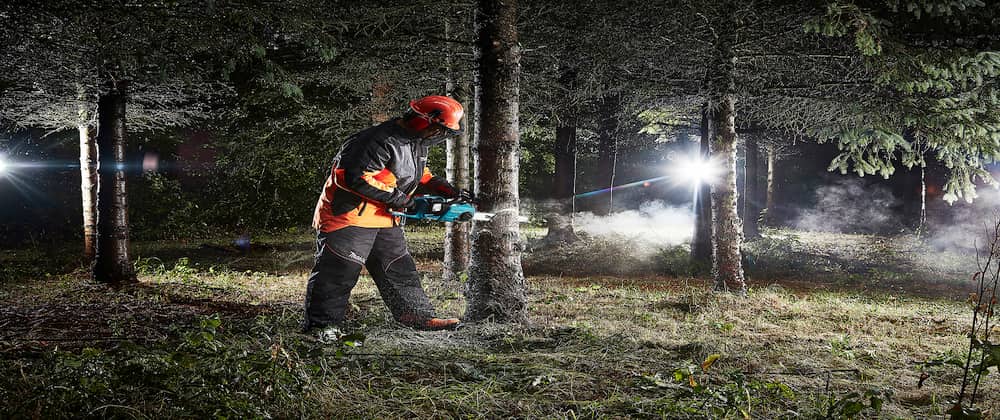
At a glance
The Makita DUC353Z came onto my radar because I was already using Makita 18V LXT tools for everything else, and I kept looking at the batteries sitting on charge and thinking there had to be a chainsaw that used them. There was. A mate who farms about fifteen miles from me had one for two years before I finally picked one up, and his view was that it was the best one he’d tried. Given that he’d been through a few before settling on it, that counted for something.
It runs two 18V LXT batteries in series for 36V, with a 1,100W brushless motor and a 14″ bar as standard. The bar takes up to 16″ if you want more reach, and the recommended range is 12″ to 16″ depending on the work. The chain is 3/8″ pitch, the saw weighs 3.3 kg without batteries and somewhere between 4.6 and 5.5 kg depending on which LXT batteries you fit, and the oil tank holds 200ml. Vibration runs at 5.9 m/s² cutting wood, which is not low but is less than you’d feel from a comparable petrol saw running hard. On paper it’s equivalent to a 32cc petrol saw, which isn’t a huge machine but isn’t a toy either. In practice, for the work I wanted it for, it’s been exactly that. There is nothing revolutionary happening here. It is a well-made cordless saw that does what it says and costs you nothing in fuel, mixed two-stroke, or carburettor cleaning on a Sunday morning when you just want to cut something quickly. It is sold tool-only on Amazon UK with batteries and charger bought separately. Kit versions with two batteries and a dual charger are also available, and the tool carries a three-year warranty.
Overview and first impressions
The LXT system is Makita’s core 18V platform, and it has been going long enough that the chances are reasonable you already own something that runs on it. The batteries in my drill, my circular saw, my hedge trimmer: all of them go in the DUC353Z. That changes the economics considerably. If you’re buying into this saw fresh, you need two batteries and a charger on top of the tool cost. If you’re already running LXT, you can pair whatever you have and start cutting immediately, and the DC18RD dual-port charger will charge both batteries at once, which takes less than an hour for two 5Ah packs and matters more than it sounds once you’re mid-session and need to keep going.
The important thing about matching pairs: the saw takes two batteries in series, and if you pair different capacities, a 5Ah with a 4Ah for instance, it stops when the lower capacity one is empty. Not when both are flat. Run matched pairs and that doesn’t happen. It sounds obvious once you know but it isn’t spelled out anywhere at the point of purchase, and I’ve seen people confused by it.
For the battery itself, the BL1850B (5.0Ah) or BL1860B (6.0Ah) are the sensible choices. You want the capacity without the weight. Charging window runs from 10°C to 40°C, and in a cold British winter that can be relevant: below 10°C the charger will slow or stop, so don’t assume a battery left in an unheated outbuilding overnight is going to be ready and charged in the morning. The tool is fine to use in cold weather; the charging is the constraint. If I know I need to work in the cold the next day, I charge the night before while the house is warm.
Specifications and scores
How it performed in our tests
The first real test I gave it was clearing a section of ash that a storm had brought down across the back of the field. The pieces were not small, and some of them had been sitting in the wet long enough to start going in a direction I wouldn’t have chosen. The saw worked through them without drama. Chain speed tops out at 20 m/s, the brushless motor delivers the torque consistently rather than tapering off as you feed it harder, and the 14″ bar handles everything up to about 25 cm diameter comfortably in a single pass. Go past that, or push the cut rather than letting the saw lead it, and the overload protection kicks in and stops the motor. Annoyance when it happens, though you do it less as you get used to what the saw wants from you.
The tree surgeon I know ran it alongside his own kit when he came to take down a tree Storm Arwen had loosened and declared it his favourite of the battery saws. He used it himself for the branch pruning before the main fell. Beyond 20″ of diameter in sustained bucking it starts to feel like it’s working harder than you’d like and battery life compresses, so that’s the honest ceiling. Below that it moves cleanly through soft and hardwood alike, and for firewood cutting, limbing, clearing, it is fast, quiet by comparison with petrol, and takes about five seconds to be ready to use from cold.
The sound level is notable. 89 dB(A) at the operator’s ear is still going to want ear defenders, but it’s meaningfully different from a petrol saw in both the level and the quality of the noise. It doesn’t carry across the field the same way, and the neighbours who would normally appear at the fence within thirty seconds of a petrol saw starting didn’t bother. That’s not nothing when you’re working near houses.
Match your battery pairs. The DUC353Z stops when the lower-capacity battery runs out, not when both are flat. A 5Ah paired with a 4Ah cuts your session short by the difference between them. Run matched pairs and this never happens.
Battery system and runtime
On two 5Ah batteries in continuous cutting at full speed, I got around 30 to 35 minutes before the saw stopped. In mixed use, starting and stopping between pieces, moving around, the elapsed session time stretches considerably: 40 to 45 minutes of intermittent cutting rather than sustained running. Single pair for smaller jobs, two pairs for anything extended, with the dual charger running alongside the work. The capacity indicator on the body of the saw shows remaining charge per battery when you press the check button: a quick way to know whether to start the next cut or grab the charged pair first. The saw also has over-discharge protection that stops it automatically at low battery, same behaviour as the Husqvarna and Stihl saws: sudden stop rather than gradual fade.
The BL1850B (5.0Ah) or BL1860B (6.0Ah) are the sensible battery choices for this saw. The 6Ah packs add weight for a modest runtime gain; the 5Ah is the better balance for most users. The DC18RD dual-port charger charges both batteries simultaneously in under an hour for two 5Ah packs, which is the pairing worth knowing about from the start. The charging window runs from 10°C to 40°C; in cold weather keep charged batteries somewhere warm rather than the outbuilding. If you have a spare pair, keep one in a pocket close to your body while working: lithium cells in the cold lose capacity faster than they do at room temperature, and the one in your pocket will perform better when you swap it in.
Performance and limitations
The tool-less chain tensioning is genuinely one of the better implementations I’ve used. A dial on the side cover and a lever that locks the panel: you turn the dial, the chain tensions, you lock the cover. No wrench, no side panel removal beyond the lever. It works. The one awkward thing, and I wouldn’t call it a problem, is that fine adjustments when the chain is close to right take a bit of fiddling to get your fingers into the right position. Check tension after the first few cuts on a new chain because they stretch initially; after that it settles. The same lever-and-panel system means assembling the guide bar and chain in the first place needs no tools either, which I found out when I assembled it in the car park rather than at home and was grateful for.
The trigger works on variable speed: lighter pressure for slower chain speed, full pull for maximum. There is also a constant speed control button that locks the trigger at maximum for sustained cutting without holding full pressure the whole time. The lock-off lever prevents the trigger from activating without being deliberately depressed, which combined with the main power switch means two separate intentional actions before the chain moves. I don’t find this feels cumbersome once it’s habitual; before it became habitual it meant starting with the trigger and wondering why nothing happened about once a session. Overheat protection is also in there: if the saw gets too hot the capacity indicator blinks and it stops. Let it cool, and it starts again. It has happened to me once, on a hot day in July cutting a long session of green wood.
I was annoyed by the auto power-off exactly once: switched on, got distracted, came back to a saw that had put itself into standby. It trips after about ten seconds without trigger activation. Re-engaging is thumb-on-the-lever while holding the saw ready, so it’s quick enough. The chain brake tests before each use: push the front hand guard forward with the saw running and the chain must stop immediately. Same for the run-down brake: release the trigger and the chain should stop within a second. Both are worth doing, not just as a formality. The inertia-activated kickback brake will also stop the chain without any hand contact if the kickback force is sufficient.
The spike bumper is something I didn’t pay much attention to until I used the saw on larger sections and felt the difference. Brace the spikes against the wood, pivot through the cut rather than pushing with the bar. It’s the difference between a controlled cut and wasting effort pushing a saw that doesn’t need it. The chain catcher sits below the bar and will catch a broken or derailed chain before it gets anywhere it shouldn’t. I’ve seen it work once. I’d rather not see it work again but I’m glad it’s there.
Maintenance is the easy part. No air filter, no spark plug, no fuel mixing, no carburettor to clean when it’s been sitting for three months. Chain sharpening is the main recurring task and the one that most affects how the saw feels to use. The signs to watch for: sawdust coming out mealy rather than chipped, the saw starting to push rather than cut, or the saw wanting to pull to one side rather than tracking straight. The 90PX chain that comes as standard wants a 4.5mm file; if you switch to the 91PX it takes a 4.0mm. The depth gauge matters more than most people bother with until the chain starts dragging rather than cutting: the manual figure is 0.65mm, and when the cutters wear down past 3mm it is time for a new chain rather than another sharpen. The bit that cost me a chain once: I fitted a new one without checking the sprocket, which had worn enough to start chewing through the new chain from the first session. If the sprocket looks worn when you go to change the chain, change both together. It costs less than the chain you will otherwise destroy.
- Uses any Makita 18V LXT battery pair
- Tool-less tensioning and assembly
- Consistent motor output; no taper as battery drains
- Available on Amazon UK; 3-year warranty
- Preferred by a professional tree surgeon over his own kit
- Stops when lower-capacity battery runs out if packs mismatched
- 30-35 min continuous cutting per pair is limiting for heavy sessions
- Not suited to sustained large-diameter felling
- Fine chain tension adjustment slightly awkward
- Existing Makita LXT users
- Firewood, clearing, limbing, storm damage
- Anyone wanting Amazon availability and simple maintenance
- Noise-sensitive or enclosed working environments
- Sustained felling of large timber (20″+ diameter)
- Users with no existing LXT batteries (high startup cost)
- Milling or extended professional commercial felling
Final verdict: is it worth it?
If you’re already on Makita LXT, this is a fairly obvious purchase at any point you need a chainsaw. The platform argument alone makes it compelling, and the saw performs well enough to back it up. For everything up to moderate felling and sustained firewood processing in sessions, it handles the work without the petrol overhead. If you’re starting from zero on batteries, the equation is different: two batteries and a dual charger on top of the tool is real money, and the question is whether the convenience and platform investment is worth the starting cost versus a petrol saw in the same weight class.
For sustained heavy work, repeated back cuts on big timber, milling, anything that wants a 16″ or 18″ bar running hard for hours, this isn’t the machine. The 14″ bar is the right choice for its class but it’s not a felling saw for large trees: the practical maximum diameter is around 65cm cutting from both sides on large sections, and beyond that you’re asking it to do something it wasn’t built for. Keep it for the work it’s built for and it won’t let you down.
The Oregon chain that came with mine is the thing most likely to need attention first. The bar groove wants cleaning every time you change or sharpen it, which is a slot in the bar rail that collects sawdust and chips and gradually reduces oil flow to the tip if you ignore it. The oil discharge hole at the top of the bar is a related check: if oil delivery seems poor, clean that hole out with a screwdriver before assuming anything more complicated is wrong. Both took me a few sessions to notice as part of the routine.
The DUC353Z earns its place on the strength of one argument above everything else: it uses the batteries you already have. For any Makita LXT user who cuts wood regularly, that makes it the chainsaw to reach for first. For clearing, firewood, and anything up to moderate diameter felling, it performs at the level the 32cc petrol comparison claims. Everything past that ceiling is the honest limit, and staying within it means the saw will keep pace with whatever you put in front of it.
Share on socials: