At a glance
I used this to cut hinge recesses into a run of new cupboard doors and a stopped housing groove into the side of a bookcase that was already glued up, reaching in from the back rather than starting from a flat board, and it saw both jobs through cleanly. The one thing worth sorting before any of that is the collet. Mine wouldn’t seat a bit at first, no matter how hard I pushed, and it turned out the collet hadn’t been pushed fully home into its own housing before the nut went on, so it was gripping nothing. Reseat it fully first, then the nut, and the bit goes straight in.
Check which version of this router is being bought, too, before any of that. The model code alone doesn’t tell you. The letters after the number describe the bundle, not a different tool. Bare tool with no case is one thing, bare tool in a case is another, and a case with the extra bases thrown in is a third, all the same router underneath. I’ve seen people convinced they were comparing two different machines side by side when it was the accessories doing the talking, not the tool.
The base, the depth ring, and changing bits
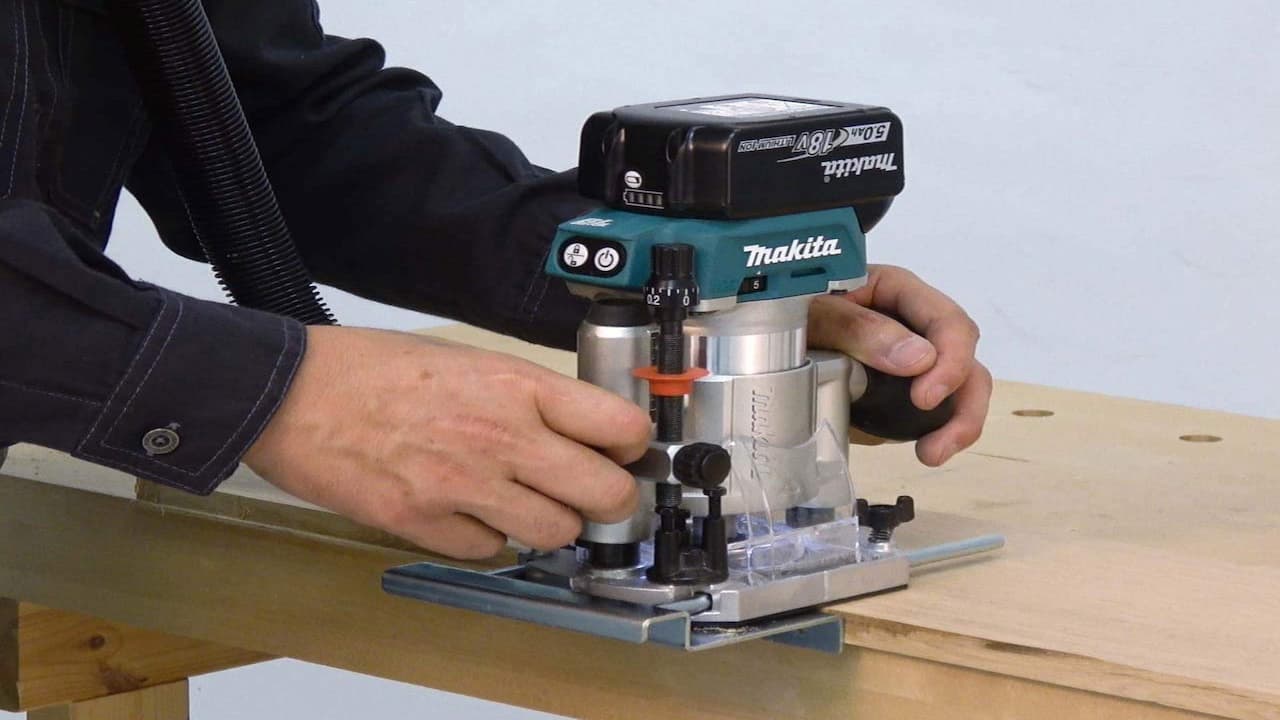
Once I’d sorted the collet, the trimmer base that comes as standard plunges further than the name suggests, forty millimetres, more range than you’d expect from something billed mainly for trim work. It’s aluminium with a plastic cover plate rather than anything you can see through, there to stop the base scratching the door fronts rather than to give you a window on the cut. A clear base exists, but it’s sold separately rather than fitted as standard, so what you’re looking through while cutting is the gap either side of the bit and the two LEDs built into the housing, not the base itself.
The depth adjustment is a rack and pinion setup, winding a knob to move the motor unit against a geared track rather than a threaded screw. No backlash to take up before it responds, which mattered on the hinge recesses, since each one needed the same shallow depth repeated across every door without drifting a fraction between them.
Bit changes go through a shaft lock, a big red button on the housing that’s easy to find without looking, holding the spindle still while you work the nut. Two different sized wrenches are needed across the job, one for the base clamp and a smaller one for the collet nut, so it’s worth having both to hand rather than assuming one does everything.
Specifications and scores
How it performed in our tests
I ran the speed dial up for the housing groove and down for the fiddlier hinge recesses, the range stretches from ten thousand up to thirty thousand rpm, and the motor holds whatever speed you set rather than surging or bogging as the cut gets easier or harder. That electronic feedback does draw more from the battery on the harder passes, which is part of why how far a charge stretches depends more on what you’re cutting than the number printed on the battery. Soft start ramps the motor up rather than snapping straight to full speed the second the trigger goes, and on something this light that matters most in the first instant of a plunge, exactly when a sudden kick could nudge the whole thing off the line before the cut has even started.
Lock on is a push button pad on the front rather than a bump switch. Took me a few goes to stop reaching for a trigger that wasn’t there, but it’s second nature after a day of use and never once got in the way once I’d adjusted to it.
For the housing groove reaching into the back of the already assembled bookcase, losing the cord entirely was the whole reason this got picked up over a corded router. There was no way to run a cable in and still have room to hold the tool steady, and going cordless made a job that would otherwise have needed the carcass built in stages instead possible after the fact. Loaded with a 4Ah battery, the whole thing stood comfortably clear of the opening even with a straight cutter set for the stopped run. I ran the same router earlier across roughly twenty feet of plywood, eight feet of oak and ten feet of pine in one sitting for the doors and shelving, cutting cleanly through the oak without the motor ever sounding like it was working for it, and still had four bars left on the gauge once I’d finished, which says more about what a charge actually stretches to across a mixed job than any single number would.
If a bit won’t seat, check the collet is pushed fully home before assuming it’s the wrong size. A collet sitting proud in its housing grips nothing, even when the size is correct.
What’s in the box, and the wider system
Dust extraction routes through a nozzle sized to fit Makita’s usual thirty-two and thirty-seven millimetre connections, and since I already run one of their extractors for other tools, this one just plugged straight into the same hose with nothing extra to buy. Anyone starting from nothing needs the dust nozzle as its own separate purchase rather than assuming it’s boxed in with the bare tool.
A plunge base is sold separately from the standard trimmer base, plunging a touch less at thirty-five millimetres. Neither the doors nor the bookcase needed one, the trimmer base covered both fine, but it’s on my list for the next job that wants proper repeat-depth control, since it adds three preset stops for going back to a setting without dialling it in fresh each time, a lock lever for holding position mid-cut, and a sub-base that takes standard template guides. There’s an offset base and a tilt base too, both bought separately again, so getting into this fully is more a case of building the system up over time than buying the one box and being done.
A guide rail adapter is sold to let this router ride Makita’s own track system, the same rails their circular saws use. If those rails are already sitting in the workshop for another tool, long dead straight grooves stop needing a clamped straightedge for every single pass. Collet cones in a few different sizes are sold separately too, and they’re not spare collets themselves, they’re what converts the housing to take a different size. Buying one on a guess rather than checking which sizes the bits already owned need just adds a part to the toolbox that solves nothing.
Performance and limitations
Sound sits around eighty-one decibels once you’re well into a cut, and you feel the same jump in vibration through your hands, barely 2.5 metres per second squared spinning free, up to 4.5 the moment the cutter loads into a groove, a real difference rather than a number that only matters on paper. Weight shifts with whatever battery’s clipped on too, 1.8 kilos with the smallest pack, 2.1 with the biggest, noticeably front-heavier with the larger one, so it’s worth trying your own battery on it before assuming the bare tool weight is what you’ll be holding.
Registration wasn’t something I had to think about here. The three year cover is standard on Makita’s side rather than something you have to claim back with paperwork, though it’s always worth checking the exact terms haven’t shifted since. If this is a first tool onto the 18V LXT platform rather than an addition to a set already owned, genuine batteries cost more than the clones going on marketplace listings, but a sale or a multipack brings that gap down close enough that it’s not worth the fire risk stories that keep circling round the cheaper packs.
- Smooth, repeatable rack and pinion depth adjustment
- Wide 40mm plunge range on the standard base
- Genuine three year warranty, no registration hoop
- Speed holds steady under load across a mixed job
- Collet must be seated fully home or bits won’t grip
- Plunge, offset and tilt bases all sold separately
- Model code system is confusing when comparing listings
- Pad-style lock-on switch takes a short while to adjust to
- Anyone already on the Makita 18V LXT platform
- Hinge recesses, housing joints and detailed trim work
- Anyone happy to build the base system up over time
- Anyone wanting every base included in one bare-tool box
- Heavy, sustained stock removal rather than detail work
Final verdict, is it worth it
By the time both jobs were done, the hinge recesses sat identical across every door and the housing groove came out square with no wobble at the stopped end where visibility was worst. The one thing that actually slowed me down all day was fighting a bit that hadn’t been seated properly in the first place, and that took two minutes to sort once I knew what to check.
A precise, well-behaved trim router that earns its keep on detail and joinery work, provided the collet’s seated right and the base system is built up as needed rather than expected in one box.
Share on socials: