At a glance
This is the first robotic mower I’ve lived with for an entire season, and the thing that struck me most wasn’t the mowing at all. It was how much of the experience is decided before the mower ever turns a blade, in the ground, with a length of wire and a tape measure. If you’re still weighing up whether a robotic mower is even the right type of lawn mower for your garden, that’s a question worth answering before this review, not after it. The Automower 305 itself is genuinely excellent. Getting it to that point takes real, deliberate effort.
It covers up to 600m², handles slopes up to 40% inside the lawn, and weighs a manageable 9.4kg. The question wasn’t really whether it can cut grass well, Husqvarna have been doing this since 1995 and it shows. It was whether the compact, wire-guided approach genuinely holds up against the GPS and camera-based alternatives now on the market, once you’ve actually lived with it through a season.
Overview and first impressions
This doesn’t use GPS or satellite positioning, that’s reserved for Husqvarna’s “X” range further up. The 305 finds its way around a physical boundary wire buried or pegged into the lawn, which means the real work happens at installation rather than in an app. Doing it myself on a modestly sized garden took a genuine afternoon, three hours all in, and I’ve heard from others that a professional install on a larger, more complicated garden took barely an hour, worth factoring in if you’d rather pay for the time than spend it.
The boundary wire isn’t included, only the charging station, six spare blades, the power supply and a 5m low-voltage cable come in the box. You’ll need an installation kit with the loop wire and stakes bought separately, and a guide wire run through the garden to help the mower find its way home faster. Pegging the wire down is quicker than burying it, but expect to refix it once or twice in the first few weeks if you peg rather than trench, the grass simply hasn’t grown over and protected it yet.
Before any of this, the grass needs cutting down to a maximum of 10cm and any holes in the lawn filled in, an uneven lawn with standing water in a dip can genuinely damage the unit. Once installed, Husqvarna are explicit that the cutting height should start at maximum for the first few weeks specifically to avoid the blades nicking the freshly buried wire, then be lowered gradually after that.
The keypad and display sit under a hatch rated IPX5, so they survive a wet morning without issue, and lift and tilt sensors cut the blades instantly the moment the body is lifted off the ground or tipped over. Husqvarna are clear that everyone needs to stay a minimum of 3 metres away while it’s actually running, not just out from underfoot.
Don’t cut too low too soon. Running the cutting height low before the wire has settled in risks nicking it, and that means repeated repairs rather than just a closer cut. Start at maximum and step down gradually over the following weeks instead.
Specifications and scores
How it performed in our tests
Once installed and settled in, this genuinely impressed me. A section of lawn with porcelain slabs embedded into the grass, an awkward mix of hard edges and narrow grass strips between them, came up cleanly, the mower working into the gaps between slabs without getting confused by the change in surface or the angles involved. That’s a harder test than it sounds, and it passed comfortably.
The cutting height dial offers eight positions rather than a simpler few, and after starting at maximum as instructed, I settled on a middle setting once the wire had bedded in properly. Going lower than that produced repeated nicks in the boundary wire requiring repair, a real lesson rather than a hypothetical one, so I’d genuinely recommend easing down gradually rather than chasing the shortest cut straight away.
Coverage isn’t systematic the way a robot vacuum works through a room, it doesn’t start in the same spot or pick up where it left off, it just wanders. Despite that, the finished lawn looked genuinely even every time, the little-and-often cutting style clearly does what Husqvarna claim it does. Frost Guard kept it parked whenever the temperature dropped below 5°C, a sensible, automatic bit of lawn care rather than something I had to think about myself.
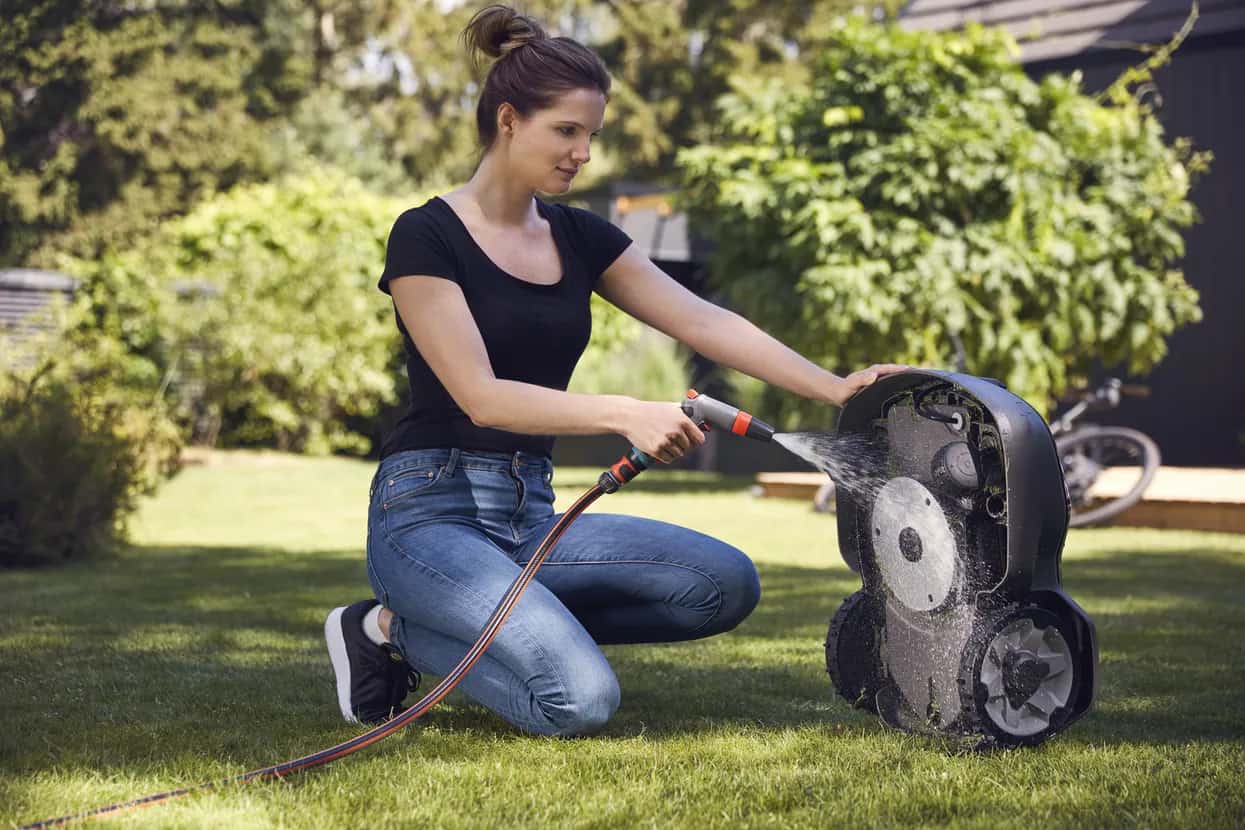
Maintenance is genuinely light but not zero: the three blades typically last 3 to 6 weeks depending on use and ground conditions, and Husqvarna are clear all three need replacing together with fresh screws each time to keep the cutting disc balanced. One detail worth knowing on a site like this one: the manual is explicit that you must never clean it with a pressure washer, a soft brush and a garden hose only, solvents are off the table entirely.
Match the schedule to your actual lawn size, not the maximum capacity. Husqvarna’s own guidance suggests roughly 4-5 hours a day for a 300m² lawn, rising to 9-10 hours for the full 600m². Running it more than your actual lawn needs just adds wear to the grass and the mower for no real benefit.
Setup and navigation
The boundary wire itself needs real care. It has to sit 35cm from anything taller than 5cm, 30cm from anything 1-5cm tall, and 10cm from anything under 1cm, with every part of the lawn within 35m of the wire itself. Slopes steeper than 15% right at the edge need the wire pulled back a further 20cm. None of this is complicated, but it is precise, and skipping the precision is exactly what leads to the boundary problems other owners report.
Finding its way home uses three blended methods in sequence: wandering for the first 3 minutes once the battery gets low, then following the guide wire for roughly the next 8 minutes, then the boundary wire after that. The charging station needs 3 metres of clear space in front of it and 150cm either side, more room than I expected before I actually measured it out.
Bluetooth control comes as standard, free, with a 30 metre range, fine for basic start, stop and park commands from the garden itself. Full app control from anywhere, the Automower Connect service, is a separate paid extra rather than included, and there’s no Google Home, Alexa or IFTTT support even once you’ve paid for it, a genuine limitation against some newer wire-free competitors if smart home integration matters to you.
Performance and limitations
What this does brilliantly is exactly what a compact wire-guided mower should: a genuinely even, healthy-looking lawn with minimal ongoing intervention once the hard part is done. The cutting result on complex ground, slabs, narrow strips, awkward edges, was consistently better than I expected from something this size.
The instalment process is the honest trade-off. There’s no GPS shortcut here, no walking the perimeter with an app and calling it done. It’s wire, stakes or a trench, and genuine patience in the first few weeks while everything beds in. There’s also no object detection at all, it won’t recognise a person, pet or stray toy before it reaches them, so a quick check of the lawn before each run matters more than it would with a camera-equipped machine.
None of that is really a flaw so much as the nature of this specific approach to robotic mowing. Genuinely capable once it’s set up, genuinely demanding to get there. One small note for the end of the season: it needs a full charge before storing away for winter, and a dry, frost-free spot on level ground or a wall hanger, rather than just being left wherever it stopped. Worth knowing too that removing the battery yourself breaks a warranty seal and voids the warranty outright, so that’s a job for a service centre rather than a weekend project.
- Genuinely excellent on complex, awkward terrain
- Reliable once settled in, minimal intervention needed
- Compact and properly weatherproof
- Genuinely quiet at 59dB(A)
- Genuinely demanding wire installation
- No object detection at all
- Full app control costs extra
- No smart home integration even with the paid app
- Smaller, complex gardens up to 600m²
- Anyone happy to install properly once, then mostly forget about it
- Gardens with tricky terrain like embedded paving
- Anyone wanting GPS setup with no wire at all
- Gardens regularly used by young children or pets unsupervised
- Anyone wanting full smart home integration out of the box
Final verdict
This earns its long-standing reputation honestly. The cutting result is genuinely excellent, even on the kind of complex terrain that trips up some of the wire-free alternatives, and once it’s properly installed it asks very little of you beyond an occasional check and an annual blade change.
Getting to that point is the real cost, not in money but in time and precision. Measure carefully, follow the obstacle clearances properly, start the cutting height high and bring it down gradually, and budget realistic time for the install itself, whichever way you choose to do it.
Do all of that properly, and this is a genuinely excellent compact robotic mower that more than earns the effort it asks for upfront.
A genuinely excellent compact robotic mower, particularly strong on awkward, complex lawns, that asks real precision and patience at installation in return. Held back only by the wire-guided setup, the lack of object detection, and paid-extra app control.
Share on socials: