At a glance
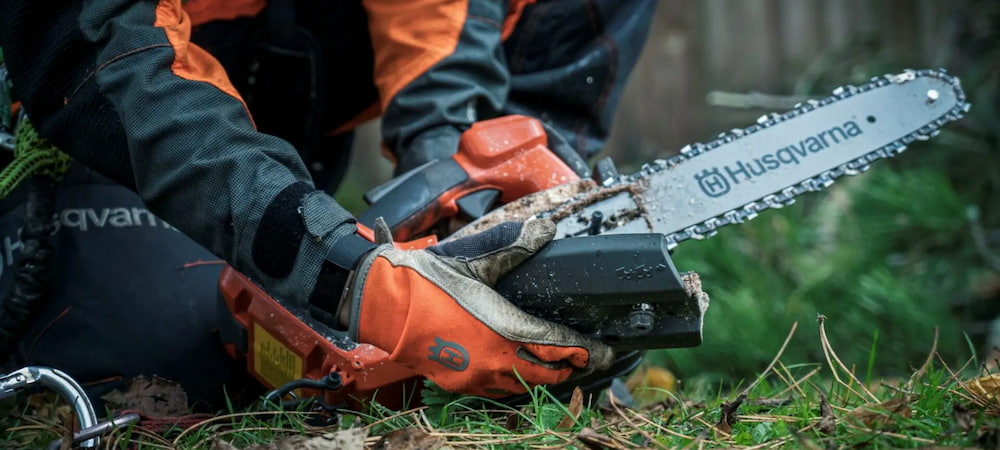
I’ve been cutting with petrol saws for a long time, long enough to know what I’m comparing against when I pick up something different, and I came to this one because I kept being told by people who use a chainsaw for a living that the Husqvarna 540i XP was the one worth looking at if you were going to take battery seriously. Not a toy. Not something you pull out for a single tree. The real thing.
It’s a rear-handle saw on Husqvarna’s 36V BLi-X professional battery system, and they position it as equivalent to a 40cc professional petrol saw when you pair it with the BLi300 battery. The motor is 1.8 kW brushless, direct-drive with no clutch between motor and chain, meaning the instant you pull the trigger you have chain speed. No ramp-up, no slip, just cutting. It’s a different feel from a petrol saw, and once you’re used to it, you notice how much you’d been compensating for that ramp-up without realising.
Overview and first impressions
The 540i XP is a professional-grade saw and doesn’t make any apologies about what that means for cost and who it’s built for. Husqvarna sell it tool-only, so there is no battery or charger in the box. If you’re new to the BLi-X system that means buying both separately, and a new battery from the factory is only 30% charged, which is one of those things you find out either because you read the manual or because you pick up your new saw and wonder why it’s already nearly flat. Either way, charge it first.
The standard UK model comes with a 35 cm (14″) bar fitted with the S93G chain, 3/8″ mini pitch, and there’s room to run up to a 40 cm (16″) bar if the work calls for it. Chain speed at full power is 24 m/s; savE mode drops that to 18 m/s and extends the battery. The bare saw without battery, bar, chain, or oil weighs 2.9 kg. Add the BLi300 at 2.0 kg and you’re carrying about 4.9 kg, which is competitive with a mid-range petrol saw and better balanced, because the weight sits back where the engine would be rather than pulling the nose forward. The S93G chain and the SP21G alternative both sharpen with a 5/32″ (4.0 mm) file.
The saw is IPX4 rated, meaning it is cleared for use in rain and splash water from any direction, which in a UK context means you don’t have to pick your days. It shuts itself off automatically after three minutes idle, a battery-protection feature that matters less if you’re actively working and more if you step away and forget. There is also a warning indicator on the keypad that flashes if the chain brake is engaged, if there’s a temperature risk, or if the motor is under overload; a solid light rather than flashing means call the dealer. The saw has Bluetooth built in for connection to the Husqvarna Connect app, which gives you runtime data, service reminders, and last known GPS location, and to the Fleet Services platform for commercial fleet tracking. How much of that you use depends on how you work, but the connectivity is there rather than needing to be retrofitted.
One thing worth knowing: the 540i XP was discontinued by Husqvarna not long before this was written. Dealer stock in the UK is available and parts and service are not going away any time soon, but it’s end-of-line rather than current production.
Specifications and scores
How it performed in our tests
I used it first on ash that had come down in a gale and been lying in the field for a few months, which tends to grab and split at inconvenient moments, and it cut through without complaint. Fast, clean, no hesitation. What it doesn’t do, and this takes a session or two to trust, is fade as the battery gets lower. The power is flat across the whole charge, same speed, same torque, right to the end, and then it stops. Not slows. Stops. The first time that happens mid-cut it gets your attention. After a few sessions you start checking the charge indicator before starting anything serious rather than waiting to feel the dropoff, because there isn’t one.
On the species that test a saw: oak at 20 cm, dense hazel that had been left for twenty years, proper ash trunk sections, it did the work. In a harder test, sustained felling of smaller to mid-sized mixed hardwood, oak and birch averaging around 25 cm, a single BLi300 charge covered fifteen trees before needing to swap, which tells you something useful about where the battery actually lands in practice rather than on a specification sheet. On the larger end of the range, a long back cut through a full trunk in one pass, it wasn’t effortless. You feel it working. Rushing the cut doesn’t help and neither does arm pressure. What does help is using the spiked bumper, getting it against the trunk and rotating through the cut with body movement. The saw rewards that the same way a professional petrol saw does, and using it as if it were a consumer machine is how you get it to work harder than it needs to.
The sound level is lower than any petrol saw I’ve used, and it’s a different quality of noise, not just quieter. The measured figure is 95 dB(A) at the operator’s ear, which still wants ear protection, but it doesn’t carry the way a petrol saw does and it doesn’t produce the through-the-teeth vibration that a hard-revving four-stroke sends through your skull. The people at a job I was on came out at one point to see what was happening and seemed faintly surprised a chainsaw had been running for two hours.
One thing that needs conscious adjustment if you’ve spent years on petrol: there is no engine noise between cuts to remind you the saw is active. On a petrol saw the idle is audible and persistent. On this one it’s silent the moment you let go of the trigger. The trigger lockout means it won’t run by accident, but the mental habit of treating a silent tool as a safe one comes naturally, and it shouldn’t. The chain brake needs engaging between cuts more deliberately than it does on petrol. The inertia-activated brake will stop the chain in a kickback, and the manual activation via the front hand guard works as you’d expect, but neither substitutes for the habit.
Watch the charge before a significant cut. The 540i XP has no power fade warning. It cuts at full power and then stops. If you’re mid-back-cut on a tree that is starting to commit to a direction when the battery runs out, that is a bad moment. Check the charge indicator before felling cuts, not during them.
Battery system and runtime
If you want the full 40cc petrol equivalence, the battery you’re running is the BLi300: 9.4 Ah at 36V, 2.0 kg. In mixed use, a session including felling cuts, limbing, and the movement between pieces that real work involves, the BLi300 gives roughly 40 minutes of actual cutting time and perhaps an hour of elapsed session time. That figure shortens if you’re doing nothing but sustained bucking of large material, and it stretches on lighter work. savE mode, which drops chain speed to 18 m/s, is worth using on the light stuff: limbing, clearing small diameter material, anything where you don’t need maximum chain speed. Disable it for the trunk cuts.
Charge time on the QC500 charger is around 60 minutes for the BLi300; the 40-C750X fast charger brings that to about 40 minutes. A full working day needs at least two batteries and a charger running alongside the work. The batteries operate in temperatures down to -10°C, with the charging window narrower at 5-40°C; below 5°C the charger holds off, which is worth knowing if your storage space gets cold overnight. The platform’s interchangeability across the full BLi-X professional range is the thing that makes the startup cost easier to justify: a BLi300 that charges in the 540i XP charges equally in a hedge trimmer or a blower on the same system. Batteries also have active thermal management that keeps them cooler under sustained load than most competitor platforms.
Performance and limitations
The direct-drive motor is something you feel from the first cut. The chain engages the instant you apply trigger pressure, no ramp and no slip point when the wood gets hard. Some operators find this more precise; others take a few sessions to recalibrate after petrol. The 542i XP uses a centrifugal clutch to give something closer to the petrol engagement feel, which is worth knowing if you end up comparing the two, but the direct-drive here is not a limitation. It’s a different system, not a worse one.
Chain tensioning requires the combination wrench that comes with the saw. It is not tool-free the way some other professional cordless saws are, and if you’ve been using a tool-free system, the wrench is the first thing you notice. In practice it’s thirty seconds per adjustment and the result is solid, but it’s a friction that accumulates over a long session of changing bars or adjusting for stretch on a new chain. The flip-up oil cap and the retained bar nuts sit at the other end of that scale: small details, until the first time you don’t have them and a bar nut goes into the undergrowth.
The saw has a chain catcher below the bar that catches the chain if it breaks or comes off, and a right hand guard that protects the operator’s hand if the chain fails. Both are solid. The chain catcher has been tested under real conditions: a twig caught in the mechanism, the chain came off, the catch did what it was designed to do immediately. Worth knowing it works before you need to know it works.
Maintenance is considerably lighter than petrol: no air filter, no spark plug, no fuel mixing, no carburetor to clean. What needs attention is the same as any chainsaw: chain sharpness and tension, bar rotation and cleanliness, oil levels. Monthly checks include measuring the brake band thickness, which should be no less than 0.6 mm at its thinnest point, and replacing the chain drive sprocket. Electronics are not user-serviceable, which means electronic faults go to a Husqvarna servicing dealer. That’s rarely a problem in practice because there is very little to go wrong electronically, but it is different from a petrol saw where a patient person with the right tools can trace most faults at home.
- Cuts with genuine petrol-class performance in real use
- Flat power delivery to end of battery charge
- IPX4 rated for UK weather use
- BLi-X battery interchangeable across full platform
- Much quieter than petrol at 95 dB(A)
- Stops abruptly at battery depletion with no warning
- Chain tensioning requires a wrench, not tool-free
- Discontinued, end-of-line product
- High startup cost if building battery platform from scratch
- Electronics need professional dealer repair
- Arborists and land/estate managers
- Clearing, limbing, and chipper work
- Users already on the BLi-X battery platform
- Work in noise-sensitive environments
- Heavy felling of large timber (over 40 cm)
- New BLi-X entrants (better to buy current replacement)
- Light occasional garden use (overqualified and overpriced)
Final verdict: is it worth it?
For anyone who uses a chainsaw regularly, works in places where fumes or noise are a real constraint, or is already in the BLi-X battery ecosystem, the 540i XP covers a significant amount of professional chainsaw work at a level that is hard to distinguish from a comparable petrol saw. Not all of it. The bigger felling jobs, sustained heavy bucking where runtime and raw power start to matter more, are still petrol territory for most people. But arborist work, clearing and limbing, firewood in manageable sessions, the middle ground of professional chainsaw use where a well-made 40cc petrol saw earns its keep: this does that.
The discontinued status changes the calculation slightly. Stock is available and Husqvarna’s support for existing products is reliable, but you’re buying an end-of-line tool rather than a current one, and that’s worth pricing accordingly when you’re talking to a dealer. It also means the case for buying in as a first BLi-X tool is weaker than it was; if you’re starting from scratch you might be better served by what’s replaced it. The standard warranty is one year from factory; Husqvarna also sell a Warranty Plus extension that can be activated within thirty days of purchase for additional cover beyond the standard term.
Two things I’d say plainly rather than bury. The abrupt stop at battery depletion is a thing to prepare for rather than just note: it doesn’t taper, it doesn’t warn, it stops mid-cut, and if you’re mid-back-cut on a tree that was starting to commit to a direction, that is not a moment to be without your saw. Know where your charge is before the significant cuts start, or carry a charged spare. And the chain tensioning wrench is a friction over a long day that tool-free systems don’t produce. Neither of these is a reason not to buy it.
The 540i XP is the closest a battery chainsaw has come to replacing a professional petrol saw for a meaningful range of real work. Discontinued does not mean worn out. If you can get one at the right price from dealer stock and you’re already on the BLi-X platform, the performance and build quality are not in question. If you’re starting from scratch, look at what has replaced it first.
Share on socials: