At a glance
Most robotic mowers wander a lawn at random and hope to eventually cover everything. The Sileno City 300 does that too, but it also comes with a second wire most competitors don’t bother with, specifically there to reach the parts of a complex garden random wandering would otherwise miss. That one extra wire turned out to define almost everything about owning this machine, for better and for slightly more effort.
It covers up to 300m², handles slopes up to 35%, and weighs a genuinely light 7.3kg. The question was whether that extra wire, and the extra installation step it demands, is actually worth it over a simpler wire-only mower.
Overview and first impressions
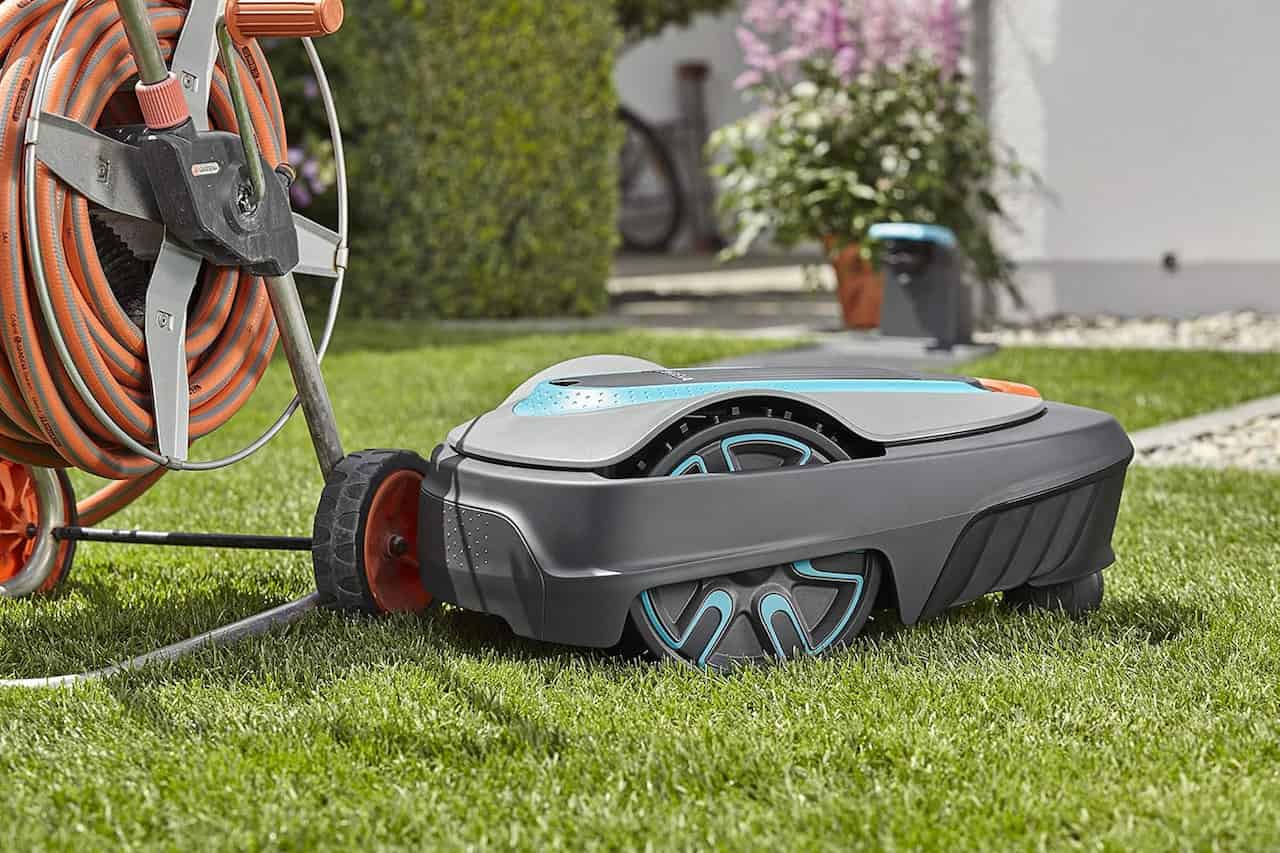
The cutting system sits in the middle of a compact, blue-grey chassis, with a tool-free dial on top adjusting height between 20mm and 50mm, and a simple keypad and monochrome screen under a hatch for direct control. Bluetooth comes as standard with a 10m range, fine for basic commands from the garden itself, though the full Gardena smart system with proper remote app control needs a separate Gateway accessory, a genuinely significant extra outlay on top of the mower itself, not included by default.
In the box: the mower, charging station, a 150m reel of boundary cable doubling as the guide wire, hooks to peg it down, couplers and connection terminals, a power supply with a 5m low-voltage cable, and a printed manual. The maximum total length the wire can run is 300m, worth knowing before you start measuring out a genuinely large or complicated garden.
Before installing, the manual is clear that holes in the lawn with standing water can damage the unit, the same warning I’d expect from any wire-guided mower in this category. It’s weatherproof and will mow happily in the rain, though heavy rain or thunderstorms aren’t recommended.
A four-digit PIN code protects against theft, any combination except 0000, and lift and tilt sensors cut the blades the moment the chassis is lifted or tipped, on top of the collision sensor that handles solid obstacles day to day. Frost detection automatically suspends the mowing schedule whenever temperatures get close to freezing, a sensible bit of automatic lawn care I never had to think about myself.
The smart app control costs extra. Bluetooth from the garden is included, but full remote control from anywhere needs a separate Gateway accessory, a real cost on top of the mower itself rather than something bundled in.
Specifications and scores
How it performed in our tests
SensorCut varies the mowing direction pass to pass, and the finished lawn genuinely showed it, even and stripe-free rather than the patchy result I half expected from something working at random. CorridorCut handled a narrow strip connecting two sections of lawn from 60cm wide without any of the back-and-forth bouncing I’ve seen narrower passages cause on cheaper machines.
The real test was a section of garden split by a narrow neck of grass, the kind of layout that would normally leave one half rarely visited under pure random wandering. With the guide wire directing it to a remote starting point, that far section got mowed properly and consistently rather than occasionally and by luck.
There’s no object detection at all here, it bounces off solid obstacles rather than recognising and avoiding them, a genuine limitation worth knowing about before assuming it can be left entirely to its own devices. A garden left genuinely clear of toys, hoses and anything else worth protecting is the only safe way to run it unsupervised.
Use the remote starting points properly rather than relying on random wandering alone. If your garden has an awkward neck or a far corner, setting a guide wire start point gets it mowed reliably rather than occasionally.
Setup and navigation
This uses a single loop wire as both the boundary and the guide wire, rather than two separate cable types, a genuinely distinctive piece of engineering for this category. The guide section runs underneath the charging station and out the other side, so the station sits at a right angle to the boundary rather than directly in line with it, the upshot being the mower actually keeps the ground in front of its own charger properly cut rather than leaving the little overgrown patch some designs end up with.
The extra step most wire-only mowers skip: once the boundary loop is laid, the guide wire has to be spliced into that same circuit using the supplied connector clips, no stripping needed, but it’s a genuine extra task that adds real time to the install. The “drive past wire” distance defaults to 30cm and can be set between 20 and 30cm, and the starting point distance along the guide wire defaults to 60cm with a maximum of 300cm, useful if the charging station has to sit somewhere enclosed like under a veranda.
Because the cutting system sits in the middle of the chassis, it genuinely doesn’t reach right to a lawn’s edge, particularly anywhere raised or sunken. The manual itself recommends a 30cm gap between the wire and any raised edge, which leaves roughly a 10cm strip of grass around the perimeter that this mower will simply never cut, the kind of gap that’s usually best tidied up with proper lawn edging rather than left to chance. True right-angled corners aren’t fully reached either, since the wire has to curve rather than follow a sharp corner exactly.
Performance and limitations
What this does brilliantly is exactly what the extra wire promises: genuinely complex or oddly-shaped lawns get covered properly rather than left to chance. The stripe-free finish and the quiet motor are both real strengths on top of that, not just marketing claims.
The honest trade-off is the install itself. The extra splice is a genuinely fiddly task that sits outside plenty of people’s comfort zone, even with clips doing most of the work, and the uncut strip around raised edges and corners is a permanent, structural limitation rather than something a firmware update will fix. No object detection means the same vigilance any wire-guided mower in this category demands.
For a simple, rectangular lawn, all of that effort buys you very little over a cheaper wire-only mower. For anything genuinely awkwardly shaped, it’s the entire reason to choose this over something simpler. One small ongoing habit worth keeping: the manual recommends checking the blade disc and blades weekly while the mower is still new, a quick job that’s easy to forget once it’s been running smoothly for a while.
- Genuinely reaches awkward, complex lawn shapes
- Genuinely light at 7.3kg
- Charger area stays properly mowed, not overgrown
- Genuinely quiet, stripe-free finish
- Extra wire splice adds real install time
- Leaves a permanent uncut strip near raised edges
- No object detection at all
- Full remote app control costs extra
- Genuinely complex or oddly-shaped gardens
- Lawns split by a narrow neck or far corner
- Anyone happy to splice wire once for a tidier result
- A simple, rectangular lawn with no obstacles
- Anyone wanting full app control included as standard
- Gardens regularly used by young children or pets unsupervised
Final verdict
The extra guide wire genuinely does what Gardena claim it does. A section of lawn that random wandering alone would visit rarely got mowed properly and consistently once directed there, and the charging station’s own little patch of grass stayed tidy rather than turning into the overgrown corner I’ve seen elsewhere.
None of that comes free. The splice is a real extra step, the uncut strip near raised edges is permanent rather than fixable, and full remote control is a separate cost rather than included. For a complicated garden, that’s a fair trade. For a simple one, it’s effort spent on a problem you probably don’t have.
Match the mower to the actual shape of your lawn rather than the brand name, and this earns its place comfortably for the gardens it was specifically built to solve.
A genuinely capable robotic mower for awkward, complex lawn shapes, thanks to a guide wire most competitors skip. Held back by a fiddlier install, a permanent uncut strip near raised edges, and app control that costs extra.
Share on socials: