At a glance
I’d had my eye on a German brand for a while without ever quite getting round to buying one, mostly because the strimmers I already owned were limping along well enough that I couldn’t justify it to myself. That changed when the line feed on the old one gave up for good halfway through a job, and the FUXTEC FX-PS152 ended up being what arrived a few days later.
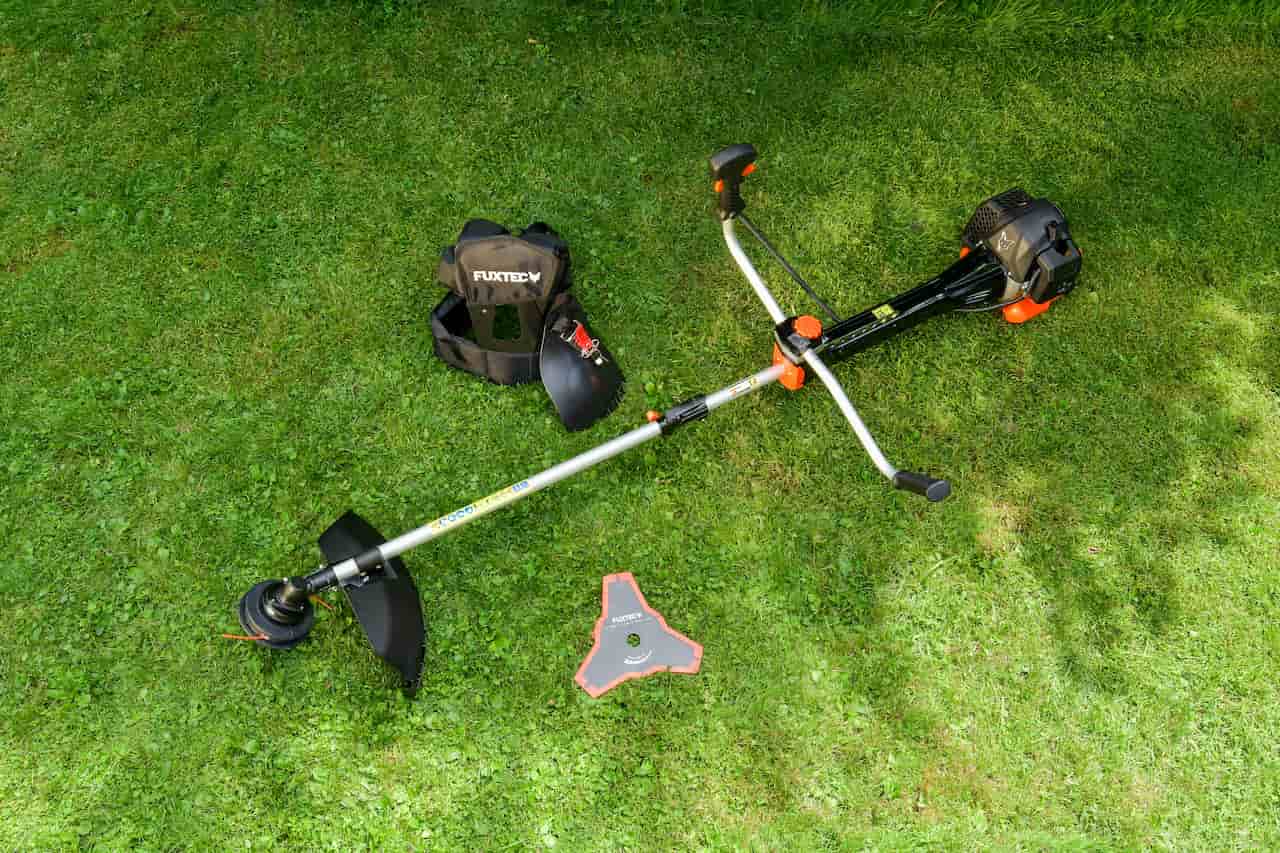
It’s a 52cc petrol unit with a line head and a 3 tooth blade included from the off, built with one eye on the domestic garden and the other on anyone doing this for a living.
Overview and first impressions
Out of the box you get the main power unit, the brushcutter attachment, the thread head, the 3 tooth blade, a protective shield, the two handed handle, a proper padded carrying harness, a mixing container, a toolkit with an Allen key, and the instructions. Nothing extra to buy before you can actually use it both ways.
FUXTEC is a German outfit, based in Herrenberg, and that shows up in small ways once you start reading the paperwork closely, mixing tables given in litres rather than anything more familiar, that kind of thing. None of it gets in the way of using the machine, but it’s worth knowing going in.
Fully built it sits at a reasonable size for a 52cc unit, and I’ll come back to the weight specifically in the next section, because there isn’t a single straightforward number to give you here.
Never lift the cutting head above knee height. Keep it low and controlled, never run it on a slope where your footing could go, and keep anyone else at least 15 metres away while it’s running. Children shouldn’t have access to it at all.
Specifications and scores
Here’s where things get genuinely odd. FUXTEC’s own spec sheet for this machine lists the net weight as 8.5 kilograms. I weighed mine on the bathroom scales out of curiosity after reading that figure, and it came out closer to 7.5, a full kilogram off what’s printed. I checked it twice in case the scales were having a bad day, and got the same lower number both times. A kilogram is a lot to be wrong by on a tool you’re going to carry on your shoulder for an hour at a time.
The noise figures have the same problem. The spec sheet quotes a sound power level of 102 decibels and, in the same breath, a sound pressure level of 111, two different measurements of two different things, which is fine on its own, except a separate test of the same model came back at 113, close to the 111 figure but not quite matching it either. And the power rating has its own quiet contradiction, the same spec table lists the engine at 1.35 somewhere and 2.2 kilowatts somewhere else, with nothing explaining which one is the real figure or what the other one is even measuring.
How it performed in our tests
Assembly is a case of few steps rather than easy steps. Fit the U handle into its bracket and do up the orange locking screw, fit the guard against the gearbox housing, then fit whichever head you’re starting with. None of that takes long, but the booklet that comes with it is thin in places and the photos are greyscale, so the bit explaining the harness’s quick release and exactly where the primer pump sits could do with being clearer. I got there without much trouble, having built enough of these over the years, but anyone doing this for the first time should set aside a bit of patience rather than expecting it to be done in five minutes.
The line head fixes on with a left hand thread, the opposite of what your hands expect, and I leant on the key the wrong way more than once before that clicked. Once it was all together, nothing rattled or worked loose over the following weeks, which is more than I can say for some machines at this price.
The blade did the heavy lifting on the bramble patch I’d been putting off all summer, going through gnarled growth and a couple of young saplings without slowing down. The line head handled tight corners, a narrow path edge and the bit round the shed foundations cleanly. Thistles and woody stems that usually need a second pass went down in one. Don’t be tempted to fit a saw blade to it for anything thicker, the manual is clear that this one’s built for the 3 tooth blade and the line head only.
Don’t let the line run down too far. If you leave it too short between top ups it can disappear back into the spool and become a proper fiddle to drag back out. Top it up before it gets that low and the bump feed keeps working the way it should.
Fuel, running time and the two cutting heads
It runs on a 40 to 1 mix of unleaded petrol and two stroke oil, though for the first couple of tank fills I ran it richer, at 25 to 1, to bed all the moving parts in properly, exactly as the instructions suggest. Worth using fuel of at least 90 octane, and don’t keep a mixed batch sitting around for more than about three months, it starts to go off and causes problems. Tank holds 1.2 litres, and once you’re working it hard rather than puttering about, that doesn’t last anywhere near as long as you’d hope, nowhere close to 45 minutes once I was really going at the bramble patch.
Starting from cold is choke up, prime the bulb 8 to 10 times until you see fuel moving, then a short controlled pull on the cord rather than a yank, about 100mm, until you feel resistance, then a couple of firmer pulls. It usually catches on the second or third attempt that way. Once it’s caught, flick the choke to the warm position and pull again straight away, then let it sit and idle for a good 10 minutes before doing anything with it. Pull the cord straight out every time, not at an angle, the manual is specific about that and I can believe why, an angled pull will fray the rope against the eyelet eventually.
Performance and limitations
The harness is the bit I’d call a real strength rather than just acceptable. It’s a proper chest and shoulder setup rather than a single strap, with a quick release clip and a hip pad on the right side specifically so the unit doesn’t rub against your hip bone over a long session. Once you’ve worked out the release, it’s comfortable enough that I forgot I was wearing it most of the time, which is more than I can say for some I’ve used.
It’s loud, there’s no getting round that, and I’d put ear defenders on as standard rather than an afterthought, along with eye protection given how much grit and small debris gets thrown about at this power. The vibration through the handle is moderate rather than mild, gloves help, and the manual’s own warning about white finger and carpal tunnel risk from extended use isn’t there for decoration.
I’ve not had it shake or stall on me, but bad vibration on starting is a complaint that crops up with these now and then, and the likely causes line up with exactly what the manual’s own troubleshooting table points at, worn internals, a weak spark, the wrong valve clearance, or a sooty cylinder head. Worth knowing before you assume something’s seriously wrong, since most of those are routine fixes rather than a write off.
- Genuinely powerful engine for the size
- Both line head and blade included from the start
- Comfortable, well thought out harness
- Nothing’s worked loose after weeks of use
- Spec sheet contradicts itself on weight and power
- Booklet is thin in places, greyscale photos don’t help
- Properly loud, ear defenders aren’t optional
- Tank doesn’t stretch far once you’re working hard
Final verdict
The engine is the part that won me over. It’s got real pull through brambles and young saplings that a lot of strimmers this size would struggle with, and the harness makes a long session bearable in a way cheaper carrying straps never quite manage.
Where it loses marks is consistency on paper rather than performance on the ground. A manufacturer that can’t get its own weight figure to match an independent set of scales, or settle on one power rating in its own spec table, hasn’t been careful enough with the documents that buyers actually rely on before they part with any money. None of that changes how it cuts, but it does mean taking the printed numbers with a pinch of salt.
If you’ve got brambles, saplings or proper overgrowth on a plot of a reasonable size, the power’s there and the harness will keep you comfortable doing it. Just don’t expect the spec sheet to be the most reliable part of the package.
A genuinely strong engine and a properly comfortable harness, let down by a spec sheet that can’t agree with itself on weight or power. Worth it for the cutting performance alone, just don’t trust every number printed on the box.
Share on socials: