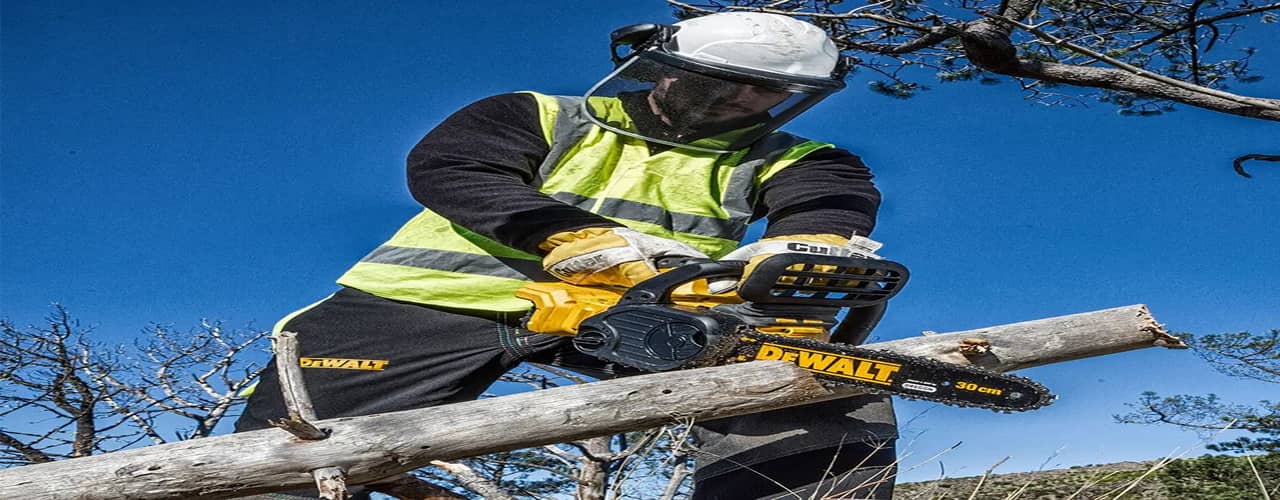
At a glance
I already had a handful of DeWalt 18V XR batteries on the shelf before I picked this up, and that was most of the argument made before I’d looked at anything else. The DCM565N takes a single 18V battery, same as the drills and multi-tools and the rest of it, and I’d been half-watching it for a while. What finally got me to buy it was getting fed up with the pull cord on the petrol saw on a Sunday afternoon when I just needed to cut something up quickly. First time I used the DCM565N I thought: why did I wait that long.
It runs a brushless motor on a single 18V XR battery, 30cm bar, and sits in the XR range alongside the drills, grinders, and everything else you might already have on the shelf. No pull start, no fuel mixing, no choke. DeWalt position it against the rest of their XR range, which is over 250 tools and accessories all running on the same batteries, and the 18V DCB184 5Ah is the recommended pairing for this saw. The chain speed tops out at 7.68 metres per second, which puts it just under the 8 m/s threshold that would require a CS39 chainsaw certificate to buy in the UK. That’s a deliberate design choice.
Overview and first impressions
I’ll deal with the weight discrepancy upfront because it comes up: retailers tend to list this at 3.6 kg but DeWalt’s own product page says 3.5 kg, and the product page is what I’d trust. That’s without a battery. The bar is 30cm Oregon TRI-LINK, the chain pitch is 3/8″, and the replacement chain if you need one is Oregon 90PX045E; the replacement bar is service part N594322. The manual states a maximum cutting diameter of 26cm. The oil tank holds 115 ml. Vibration from the manual is 3.5 m/s squared, which is on the lower end for this class and you feel the difference over a long session compared to cheaper alternatives.
The XR range is worth understanding before buying into this as your first DeWalt tool. XR stands for eXtreme Runtime. It’s the platform name for DeWalt’s 18V professional battery range. If you already own other XR tools, everything is interchangeable and the economics of this purchase look very different than they do if you’re starting from nothing and need to add batteries and a charger. The saw is sold body-only on Amazon UK and you’ll need to factor the battery and charger in separately if you don’t already have them.
Warranty is one year standard. DeWalt will extend it to three years if you register the product at MyDeWalt within four weeks of purchase.
Specifications and scores
How it performed in our tests
I cut down a couple of overgrown fruit trees that had been on the list for two years, each with trunks at the thickest five or six inches, then sectioned the whole lot. When I checked the battery afterwards it was still showing a full charge on all three bars. That was with a 5Ah DCB184 and the job took probably forty minutes of actual cutting and moving around. I had been expecting it to be running low by the end and it wasn’t, which changed my expectations of what the saw was capable of in practice.
The cutting is clean and fast on anything below about 10 inches in diameter. Above that it works but it starts to feel like it’s working rather than coasting, and I’d say 26cm is the honest maximum rather than the comfortable working range. The chain speed of 7.68 m/s is enough to move through softwood and moderate hardwood without drama, and the brushless motor delivers that consistently without trailing off as the battery level drops. The saw stops abruptly when the battery is depleted, same as every other battery saw in this class: no slowing, just a stop. I’ve never found myself in a bad spot with it because I check the charge before starting anything long, but it’s worth knowing before you put the first cut into anything large.
The noise level is notably lower than a petrol saw. Not silent, but the character of the sound is different and it doesn’t carry the same way. The neighbours, who used to time their appearances to the second any time the petrol saw started, haven’t appeared once. That’s not nothing when you’re working in a fairly ordinary suburb.
I’ve tried the saw with the stock chain and with an aftermarket full-chisel replacement, and the difference on hardwood is noticeable enough to be worth mentioning. The stock chain is semi-chisel with anti-kickback bumpers; it keeps the saw under the 8 m/s licensing threshold and it does the job, but if you find it underwhelming on dense material, switching to a full-chisel chain costs very little and improves the bite substantially.
Aftermarket chain is worth it. The stock chain is semi-chisel with anti-kickback bumpers. For hardwood or anything you’re cutting regularly, a full-chisel replacement makes a clear difference to the bite. The Oregon 90PX045E fits the 30cm bar.
Battery system and runtime
In mixed use on general cutting and clearing, the 5Ah DCB184 gives me around 45 to 60 minutes of elapsed session time before it needs a charge. The 70-cut figure DeWalt quote is on 4-inch by 4-inch pressure treated spruce with a fresh battery, which is a controlled test condition rather than a reflection of what a mixed session looks like. It’s a fair way to compare performance between tools but don’t take it as a guide to how long a bag of logs will take.
The whole XR range shares batteries. The same DCB184 that runs the chainsaw runs drills, grinders, reciprocating saws, and over 250 other tools in the range. If you’re already on XR, that makes this saw considerably more attractive than it would be if you were coming to DeWalt fresh. Flexvolt batteries (DCB546 through DCB549) are also listed in the manual as compatible; they operate at 18V in this saw and extend the runtime, though they won’t push the motor beyond what it’s designed to do. The saw is not rated for use under wet conditions or near flammable liquids or gases.
Performance and limitations
There is a known oil-leaking issue with this saw that comes up in enough places that it would be wrong not to address it. I noticed when I first stored the saw after a session that there was oil residue underneath it where it had been sitting. The oil tank holds 115 ml and the automatic oiling system lubricates the chain continuously while it runs; bar and chain oil is stickier than regular oil and it accumulates around the bar groove and guide rail when the saw is not in use, which is what people are seeing when they report leaking. It is not a seal failure in most cases. Empty the oil tank after each use and store the saw flat on the bar. When I started doing that, the residue stopped. If you leave oil in the tank and store it upright, it will seep.
Something I didn’t expect: the bar sits closer to a top-handle configuration than most rear-handle saws, which makes one-handed and overhead work easier than the category description would suggest. There is a rear handguard on the right side to protect your hand if the chain breaks or comes off. The saw is not rated for wet conditions; the manual is clear that you should not use it in rain or near flammable liquids or gases.
The four-sharpening limit in the manual is there because each time you run a file over the chain you’re reducing the profile of the anti-kickback bumpers, and by the fourth the chain’s kickback resistance is significantly degraded. When the cutters wear down past 3mm it is time for a new chain. The replacement is Oregon 90PX045E. The bit that cost me a chain once: I fitted a new one without checking the sprocket, which had worn enough to start chewing through the new chain from the first session. If the sprocket looks worn when you go to change the chain, change both together.
Maintenance is light. No air filter, no spark plugs, no carburettor, no two-stroke mix. The bar groove wants cleaning every time you change or sharpen the chain, and the oil discharge hole at the top of the bar is worth cleaning out if oil delivery seems poor. For the body itself, blow out the air vents with dry air when they collect sawdust; the plastic housing wants nothing more than a damp cloth and mild soap only, as solvents will damage the plastic. You still want ear protection with this saw; 76.5 dB(A) at the operator is not quiet, and the sound power level is 96.5 dB(A). What I found after the first few longer sessions was that the soft overmould rear handle and the large auxiliary grip earn their keep more than they appear to from just picking the saw up in a shop.
- Uses any 18V XR battery you already own
- Tool-free bar and chain tensioning
- No CS39 certificate required
- Available on Amazon UK; 3yr warranty with registration
- Much quieter than petrol; no fume or fuel overhead
- Oil leaks if stored upright with full tank
- Stock chain underwhelming on dense hardwood
- Not for wet conditions (no water rating)
- High startup cost without existing XR batteries
- Existing DeWalt 18V XR users
- Garden and smallholding general use
- Firewood, clearance, pruning, storm damage
- Noise-sensitive environments
- Sustained heavy felling (over 26cm diameter)
- Wet conditions or exposed weather use
- Users with no existing XR batteries
Final verdict: is it worth it?
If you’re already on DeWalt XR, this is a very easy decision. The batteries are already there, the XR ecosystem makes the body-only cost look reasonable, and the saw itself does the job for everything up to moderate felling without asking anything complicated of you. If you’re starting from zero on batteries, the equation is different but the answer is probably still yes if you expect to use other 18V XR tools, because you’ll get value from the batteries across the range.
The oil storage issue is real but it is a procedure problem not a product defect: empty the tank, store flat on the bar, and it doesn’t happen. The stock chain does the job but if you find it underwhelming on harder wood, an aftermarket full-chisel replacement is cheap and makes a clear difference. Neither of these is a reason to walk away from the saw; they’re both things you find out in the first week and then just deal with.
It is not the saw for heavy sustained felling, not because it is poorly made, but because a 30cm 18V cordless saw isn’t what that job requires. Used for what it is, it is a well-built, useful tool that starts every time and doesn’t smell of two-stroke. That’s about the strongest endorsement a chainsaw can get from someone who spent twenty years maintaining a petrol one.
For any existing DeWalt XR user who needs a chainsaw, this is the obvious first choice. The 30cm bar handles the work most garden and smallholding use throws at it, the platform argument is strong, and the saw performs at the level the 70-cut benchmark implies. Empty the oil tank after use and put an aftermarket chain on it and there is very little to criticise.
Share on socials: