At a glance
Snowdrops are among the first flowers of the year in UK gardens, typically blooming from January through to March depending on variety and location. They are small bulbous perennials in the genus Galanthus, and while the individual flower is modest in size, a naturalised drift of snowdrops in late winter can transform a garden bed, bank or woodland edge at a time when almost nothing else is in flower. Their arrival is genuinely welcome after months of bare ground, and for that reason alone they deserve a permanent place in most UK gardens.
They are also almost completely care-free once established in the right spot. The main skill with snowdrops is in planting them correctly at the outset, particularly understanding why planting in the green consistently outperforms dry bulbs. Get that right and they will multiply and spread for decades without further attention.
What snowdrops are and why they matter
Snowdrops are woodland plants in their natural habitat, flowering in the window between winter and spring when the canopy above them is still bare and light reaches the ground. This timing is what makes them so valuable in the garden. They bloom at a point when almost nothing else does, providing colour, early nectar for emerging bees, and a clear signal that the season is turning. In a well-established planting they cover the ground in white for six weeks or more before disappearing completely underground for summer.
They are fully hardy throughout the UK, tolerating temperatures well below freezing without any protection. Their flowers are tough enough to push through frozen ground and continue undamaged by frost, which is unusual among flowering plants. This hardiness combined with their early season makes them genuinely irreplaceable in the winter garden.
Choosing varieties
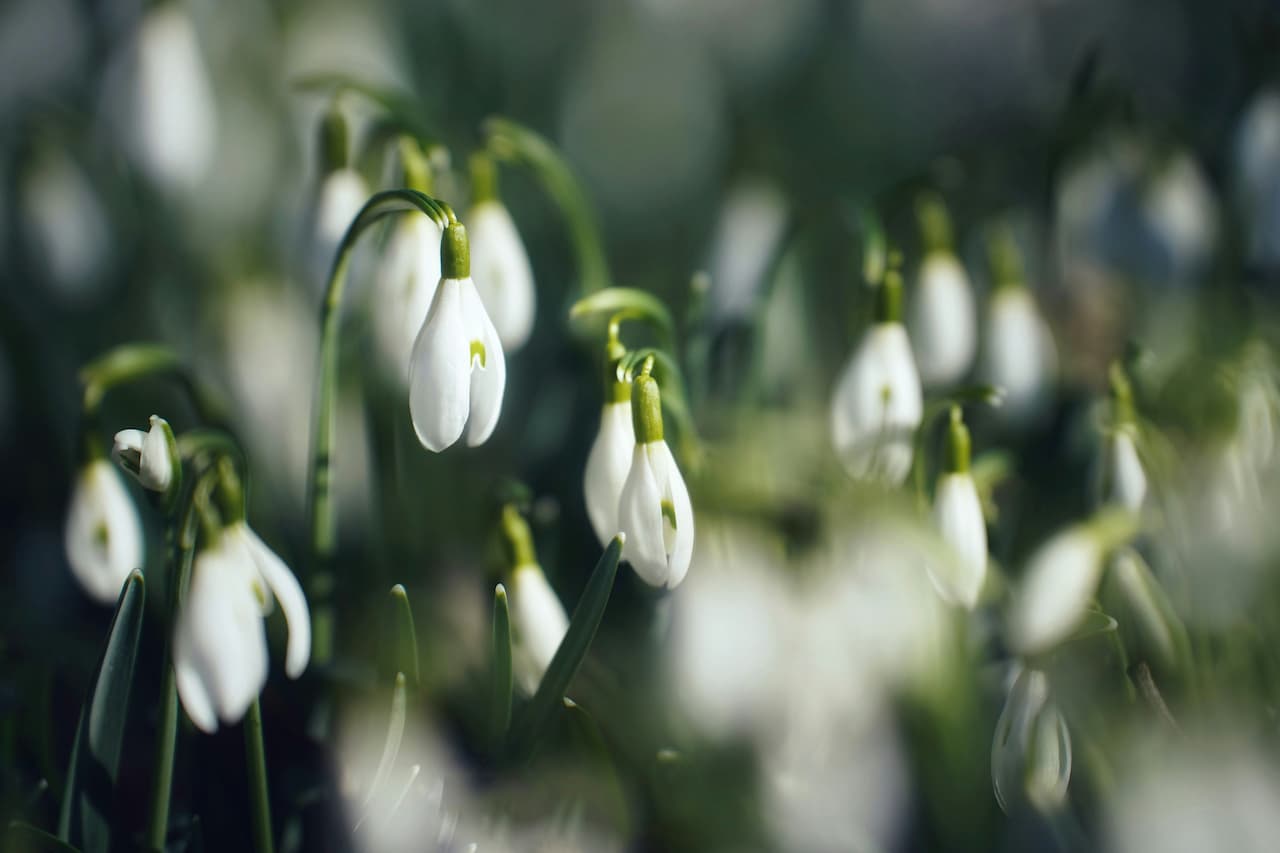
The species most widely grown and easiest to establish is Galanthus nivalis, the common snowdrop, which produces single white flowers with a green inner marking. It naturalises freely and is the right starting point for most gardens. Beyond it, a handful of varieties are worth knowing for ordinary garden use.
Galanthus elwesii, the giant snowdrop, flowers earlier than G. nivalis, often from January, and produces larger flowers on taller stems. Galanthus woronowii has distinctive bright green leaves rather than the grey-green of G. nivalis, making it interesting even before the flowers open. Double-flowered forms such as Galanthus nivalis Flore Pleno are popular and long-lasting. Galanthus S. Arnott is the most widely grown named cultivar, producing large, fragrant flowers on tall stems and reliably multiplying year on year.
Beyond these, there is a large collecting community around snowdrops with hundreds of named cultivars. Rare named forms can command very high prices. For ordinary garden naturalising, the common snowdrop and G. elwesii together provide interest from January through March without specialist cost.
The right growing conditions
Snowdrops are woodland plants and their natural habitat tells you almost everything about where to grow them. They prefer dappled shade or partial shade rather than full sun. A spot under deciduous trees or shrubs suits them perfectly because the canopy is bare when the snowdrops are in flower, allowing light to reach them, then closes over for summer when the bulbs are dormant and shade is beneficial.
Soil should be moisture-retentive but well-drained. In a heavy clay garden, adding grit and organic matter improves drainage enough for snowdrops to thrive. In a very free-draining sandy soil, incorporating plenty of leaf mould or garden compost improves moisture retention. Snowdrops dislike both waterlogged soil and dry soil. Getting the moisture balance right is the single most important factor after shade.
When and how to plant
Snowdrops establish much more successfully when planted in growth, known as planting in the green, than from dry bulbs. Dry snowdrop bulbs desiccate quickly after lifting and often fail to establish, which is why results from dry bulbs bought in autumn are frequently disappointing. Planting in the green means the plant is sold and planted while still in active growth, with leaves and spent flowers still attached, immediately after flowering finishes in late February or March. This is the most reliable method and the one to use whenever possible.
If planting dry bulbs in autumn is the only option, plant as soon as they become available in September, before they dry out further. Plant at a depth of about 7 to 8cm, two to three times the bulb’s own depth, and space them 7 to 10cm apart. Plant in groups rather than isolated single bulbs as the effect depends on mass rather than individual plants.
When planting in the green, dig a generous hole and replant at the same depth the plant was growing before, visible as a pale portion of the stem below the soil line. Firm in gently and water well. Keep the soil moist for the first few weeks while the roots re-establish.
Buy in the green, not in autumn. A pot of 25 snowdrops in the green from a reputable nursery will establish faster, spread more reliably, and give a better display the following winter than the same quantity of dry bulbs bought in September. The price difference is worth it.
Care through the year
Once established, snowdrops need very little attention. After flowering, the leaves continue to photosynthesize and build up the bulb’s food reserves for the following year. This process is essential. Do not cut back or remove the foliage until it has died down naturally, typically in April or May. Removing it early deprives the bulb of the energy it needs to flower the following winter.
Do not feed snowdrops with high-nitrogen fertiliser. A light top-dressing of leaf mould or well-rotted compost around the clumps after flowering is beneficial, but heavy feeding encourages leafy growth at the expense of flowers. Snowdrops do not need regular watering once established in suitable soil. In a very dry spring they may benefit from occasional watering while the leaves are still active, but established clumps in moisture-retentive soil are largely self-sufficient. They do not need staking.
Lifting and dividing
Over several years, snowdrop clumps build up into dense mats which can become congested. Congested clumps flower less freely than those with more space. The solution is to lift and divide them immediately after flowering while still in the green, the same window as planting new stock.
Lift the whole clump with a fork, taking care not to spear the bulbs. Separate the clump gently by hand into individual bulbs or small groups of two or three. Replant immediately at the same depth across a wider area, spacing new groups 10 to 15cm apart, and water in well. Do not lift and divide in summer or autumn when the bulbs are dormant. The bulbs are harder to find, more likely to be damaged, and slower to re-establish. In the green is always better. This spreading of divided clumps is the primary method by which snowdrops are naturalised across a garden over time.
Naturalising snowdrops in grass
Snowdrops can be naturalised in rough grass, under trees or on a lawn edge in the same way as daffodils. Plant in informal groups rather than rows, scattering bulbs randomly and planting where they fall. Allow the grass around them to grow uncut until the snowdrop foliage has died down completely, typically by May. In a formal lawn this creates a maintenance complication, but on a rough grass area, a bank or under trees it works well and once established requires no further intervention.
Snowdrops will also self-seed in suitable conditions, particularly G. nivalis. The seeds are attractive to ants, which disperse them, gradually spreading the colony naturally over years. Self-seeded plants take three to four years to reach flowering size. In a spot they like, a planting of a few dozen bulbs can grow into a carpet of hundreds over a decade without any intervention beyond leaving the foliage to die down naturally each year.
Growing snowdrops in pots
Snowdrops can be grown in containers but they are not well suited to it long-term. In a pot the bulbs dry out more easily in summer dormancy and soil temperature fluctuates more than in the ground, stressing the bulbs. If you want to try, use a deep container with good drainage, a moisture-retentive but free-draining compost mixed with leaf mould, and keep the pot in a cool shaded position through summer. The more practical approach is to grow snowdrops in pots temporarily, buying them in the green for a winter display, then planting them out into the garden after flowering to establish permanently.
Common pests and problems
Snowdrops are largely trouble-free but a few specific problems occur. The table below covers each one with its cause and the fix.
Toxicity
Snowdrops are toxic if ingested. All parts of the plant, including the bulbs, contain alkaloids that cause nausea, vomiting and diarrhoea. This is relevant to households with young children or pets. The toxicity is not typically life-threatening in small accidental doses but medical or veterinary advice should be sought if significant quantities are eaten. The sap can cause mild skin irritation in sensitive individuals. Wearing gloves when handling bulbs or dividing clumps is advisable.
Propagation
Division in the green after flowering is the main propagation method and is described in the lifting and dividing section above. Twin scaling and chipping are used by specialist growers to increase rare cultivars rapidly but are not necessary for ordinary garden snowdrops.
Snowdrops will also self-seed in suitable conditions, particularly G. nivalis. The seeds are attractive to ants, which disperse them, gradually spreading the colony naturally. Self-seeded plants take three to four years to reach flowering size. In the right spot, a planting of a few dozen bulbs can grow into a carpet of hundreds over a decade without any intervention beyond leaving the foliage to die down naturally each year.
Share on socials: