At a glance
Parsley is one of the most frequently grown herbs in UK kitchen gardens and one of the most frequently given up on at the first sowing attempt. The problem is almost always germination: parsley seeds contain natural compounds that inhibit sprouting, and germination times of three to six weeks are entirely normal. Many gardeners sow, wait two weeks, see nothing, and assume the seeds have failed. They discard the pot just days before the seedlings would have appeared. Understanding this one characteristic – that parsley is genuinely, deliberately slow to germinate – removes the main source of frustration and makes it a straightforward herb to grow.
Fresh parsley from the garden is a different ingredient from the dried jar. The flavour is brighter, greener and more complex – particularly in flat-leaf varieties – and it contributes something meaningful to cooked dishes rather than just adding green colour. It is rich in vitamins C and iron, though most people grow it primarily for flavour. As a biennial that can be overwintered with basic protection, it is one of the few soft herbs that provides genuine harvests through the colder months, making it a genuinely year-round kitchen garden plant with two sowings per season.
About parsley – the biennial life cycle and why it matters
Parsley (Petroselinum crispum) is a biennial: it lives for two years, producing leaves in year one and flowering with seed in year two before dying. In practice, most UK gardeners treat it as an annual and replace plants each year, because second-year plants produce coarser, less flavourful leaves and spend much of their energy on flowering. The biennial classification does matter in one useful way – first-year plants are genuinely hardy and will survive UK winters with light protection, giving a fresh parsley supply through the months when most herbs have stopped.
Parsley belongs to the Apiaceae family – the carrot family – which explains both its divided, ferny leaf structure and its susceptibility to carrot fly. It is native to the Mediterranean region and was used by the ancient Greeks and Romans, arriving in Britain in the 16th century. The genus name Petroselinum comes from the Greek for rock, reflecting its native habitat on rocky ground. It grows to 30-60cm tall in its leaf year, with small umbels of white or pale yellow-green flowers in year two that are excellent for beneficial insects.
Varieties – curly, flat-leaf and Hamburg
There are three distinct types of parsley worth knowing about. The choice between them affects both what you grow and how you use the harvest.
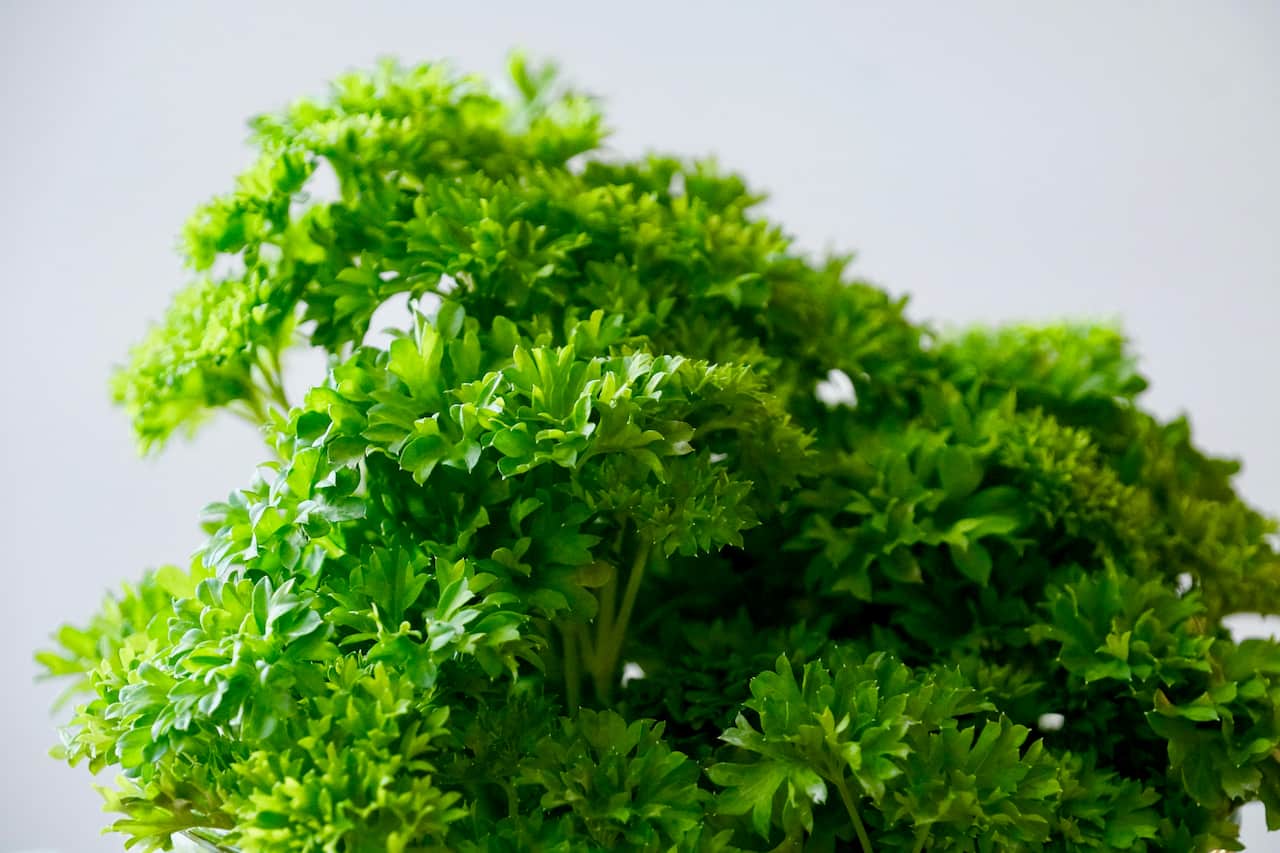
Curly parsley is the most widely grown in the UK and the form most often seen as a garnish. Its compact, ruffled leaves hold their structure well, it is more frost-hardy than flat-leaf, and it overwinters reliably with minimal protection. The flavour is good but somewhat milder than flat-leaf. Well-known curly varieties include ‘Envy’, ‘Champion Moss Curled’, ‘Aphrodite’ and ‘Bravour’. Flat-leaf parsley (also called Italian parsley or French parsley) is the better cooking choice: the flavour is noticeably stronger, with a cleaner, slightly peppery character that holds up better in cooked dishes and contributes more to sauces, stuffings and salads. It grows taller and more vigorously than curly, reaching 50-60cm, but is somewhat less hardy in a hard UK winter. Varieties include ‘Italian Giant’, ‘Gigante Napoletano’ and ‘Titan’. Hamburg parsley is an entirely different proposition: it is grown primarily for its white, parsnip-like root, which is used in soups, stocks and central European cooking. The leaves are usable but coarser. It is harvested as a root vegetable in autumn and is less commonly grown in the UK, though it is worth trying if you make a lot of stock.
For most UK gardeners, the practical approach is to grow one curly variety for overwintering and garnishing, and one flat-leaf for cooking through the main season. Both are easy, and the two together cover all the kitchen uses for parsley with very little additional effort. If you only grow one, and cooking is your primary use, flat-leaf is the better choice. If you primarily want something for the plate as a garnish, or want reliable winter leaves without much protection, curly is the more practical option.
Solving slow germination and sowing successfully
Parsley seed germinates slowly for a biological reason: the seeds contain chemical compounds that inhibit germination, an adaptation that in the wild helps time sprouting for the right conditions. Three to six weeks from sowing to visible seedlings is entirely normal. Eight weeks is not unusual in cold conditions. The seeds have not failed. The most common mistake is assuming something has gone wrong and discarding a pot that was about to germinate.
For indoor sowing, fill modules or small pots with fresh peat-free seed compost, sow 5mm deep (two seeds per module for security), and place in a propagator or warm windowsill at 18-21°C. Remove the cover once seedlings appear. Thin to the strongest seedling per module. Grow on in good light until large enough to handle, then harden off over 10-14 days before planting outside.
For outdoor direct sowing, which the plants often prefer as it avoids transplant disturbance, sow thinly in shallow drills 1cm deep with rows 30cm apart. Water the base of the drill before sowing. Thin seedlings to 15cm apart once large enough. Outdoor sowings take longer to germinate than indoor ones because soil temperatures are lower, but they establish strongly once underway. Marking the row with a fast-germinating crop such as radishes is a useful technique to avoid accidentally disturbing the parsley while waiting for germination.
Two sowings cover the whole year. A February indoor sowing provides plants ready from June through autumn. A second sowing in late May or June produces plants that carry the harvest through winter when overwintered. These two batches, combined with cloche protection for the overwintering plants, give near-continuous fresh parsley from June to the following spring without any complex succession schedule.
Growing conditions, planting out and care
Plant out hardened-off seedlings from May once frost risk has passed, spacing 15-20cm apart. Parsley performs in a wider range of conditions than most herbs, but it does have preferences that are worth following for the best leaf production.
Parsley is one of the few herbs that tolerates and actually performs well in partial shade – an east-facing bed that receives morning sun only is perfectly adequate. This makes it valuable for spots where sun-hungry herbs would fail. In containers, use pots at least 20-25cm deep and wide to accommodate the taproot, and use a peat-free multi-purpose or soil-based compost. Container plants need more frequent watering than in-ground plants and benefit from a liquid feed every three to four weeks through the growing season, as they exhaust nutrients faster in the restricted growing medium.
Parsley is a hungry herb and benefits from feeding in a way that thyme or rosemary does not. Work a balanced granular fertiliser into the soil before sowing or planting, and follow up with a liquid feed through the summer if the leaves look pale or growth slows. In fertile garden soil this is rarely needed, but in containers or in ground that has been heavily planted the previous year, it makes a real difference to leaf yield. Consistent watering matters equally – dry spells cause wilting, slow growth, and premature flowering in first-year plants.
Harvesting, using and storing parsley
Wait until the plant has established at least 8-10 leaves before taking the first harvest. Always cut from the outer stems, leaving the central growing point and young inner leaves intact. Take a few stems at a time from several plants rather than stripping one plant – this keeps all plants in active leaf production. The stems are as usable as the leaves: finely chopped parsley stems have almost identical flavour to the leaves and are wasted if discarded.
Regular harvesting actively improves yield by keeping the plant in vegetative mode. A plant that is cut regularly produces new growth continuously; one that is left untouched will start redirecting energy towards flowering sooner. Cut the outer stems right down to the base rather than snipping the tips – removing whole stems at the base allows clean new growth from the crown.
Parsley is best used fresh, where the flavour is at its most vivid. It tolerates cooking better than more delicate herbs – it can be added partway through a dish without losing all character, which makes it useful in stocks, sauces and stuffings as well as added at the end. Flat-leaf survives heat better than curly and is the better choice for anything that involves cooking the herb directly. Chopped parsley stems are as flavourful as the leaves and are wasted if discarded – include them wherever you chop the leaves. For storage, freezing works better than drying: chop the leaves finely, press into ice cube trays, fill with water and freeze. Drop a cube directly into soups, sauces or stews. The texture is irrelevant in a cooked liquid, and the flavour survives well. Drying reduces flavour significantly – dried parsley provides colour more than flavour and is a second-rate substitute for fresh.
Overwintering parsley in the UK
First-year parsley is genuinely hardy and will survive the majority of UK winters with basic protection. The approach differs slightly depending on whether the plants are in the ground or in containers, and whether you are growing curly or flat-leaf varieties.
For in-ground plants, the most reliable protection is a cloche placed over the plants before the first hard frosts. A plastic cloche or low polythene tunnel keeps the worst of the cold and wet off the foliage, maintains slightly warmer temperatures at the roots, and allows continued harvesting through winter. The plants go dormant in very cold weather but resume growth quickly once temperatures rise. Curly parsley is noticeably hardier than flat-leaf and will survive colder conditions with or without protection – it is the better choice if you want reliable winter leaf without much intervention. Flat-leaf benefits more significantly from cloche protection and may suffer in a hard winter even with a cloche, though it generally recovers from the roots.
For container-grown plants, moving the pot to a sheltered position against a south-facing wall provides significant protection through milder winters. In cold areas or during forecast hard frosts, moving pots under a cold frame, into an unheated greenhouse or against a house wall under an overhang gives extra margin. Container plants are more vulnerable than in-ground ones because the roots are less insulated, and deep freezing of the entire root ball can kill them where the same temperature would not harm an in-ground plant.
Second-year parsley overwinters but its value diminishes: the leaves become coarser and the plant’s energy increasingly goes towards flowering in the spring. Most gardeners remove second-year plants in late winter or early spring and rely on their first-year plants for the winter harvest, replacing with fresh sowings as those plants begin to run to flower. The second-year flowers are worth leaving on at least a few plants if space allows – they are a good source of pollen and nectar for beneficial insects, and you can collect the seed for next year’s sowing from plants you allow to set seed, though germination rates from home-saved seed are variable.
Common problems
Parsley shares family membership with carrots and is susceptible to some of the same pests and conditions. Most problems are manageable and rarely cause complete crop loss.
Carrot fly is the most significant pest risk. The adult flies lay eggs at soil level near the plants, and the larvae then burrow into the roots. Fine mesh netting (with sides buried in the soil) placed over plants from sowing is the most reliable protection. The flies fly close to the ground so a 60cm barrier around the bed can also be effective. Covering early spring sowings with fleece until established reduces risk significantly. Aphid colonies respond to a strong jet of water from the hosepipe for a plant you are eating from – this is more appropriate than pesticide. Celery leaf miner causes blistered or blotched patches on the leaves; affected leaves should be removed and destroyed (not composted). Slugs are a particular problem for seedlings – once established, mature parsley is much less vulnerable. Bolting in year one is usually triggered by root disturbance at transplanting, drought stress or an unexpected cold spell; it is managed by removing flower stems promptly the moment they appear, which delays the process by several weeks and returns the plant to leaf production.
Share on socials: