At a glance
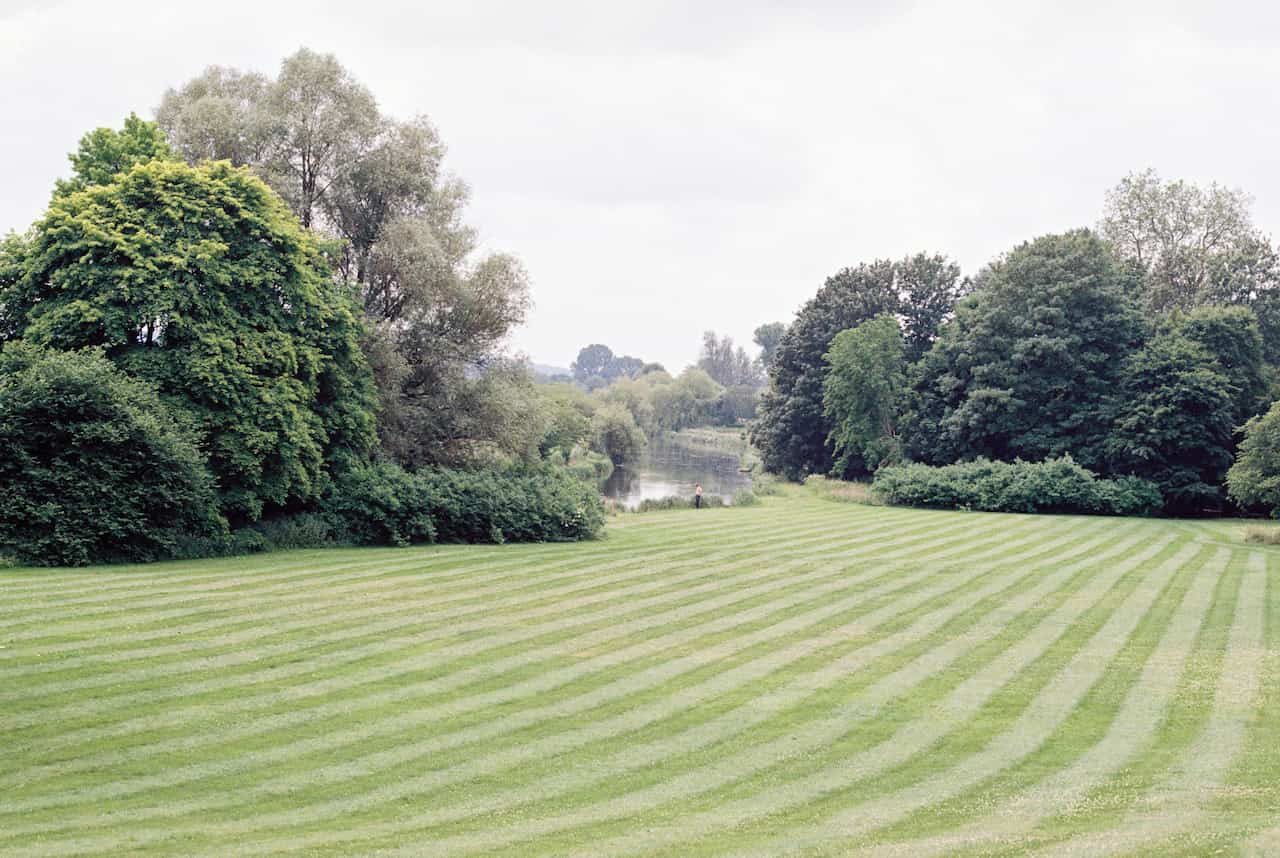
Lawn stripes are created by light reflecting differently off grass blades that are bent in opposite directions. When you mow away from you, the grass bends away and appears lighter. When you mow towards you, the grass bends towards you and appears darker. The contrast between the two directions creates the stripe effect – no colourants, no special grass varieties, just the angle of the blade catching the light differently.
This means that striping is fundamentally about bending the grass firmly in one direction as you mow – and keeping it bent until you return on the next pass. A rear roller on the mower is what does this. Without a roller, the grass springs back upright after the blade passes and no stripe forms. This is why a standard hover mower or a rotary without a roller will never produce stripes regardless of technique.
How lawn stripes work
The physics is simple. A grass blade is flexible. When a roller pushes it flat in the direction of travel, it lies at an angle. Light hitting a blade angled away from the viewer reflects back towards the viewer as a lighter tone. Light hitting a blade angled towards the viewer bounces away, making that strip appear darker. The more firmly the grass is bent, and the longer it stays bent, the more pronounced the stripe. This is why longer grass – 4-5cm – stripes more effectively than short grass. There is simply more blade to bend and more surface area to catch the light.
Stripes show best when viewed from the right angle. Stand at one end of the lawn and look along the stripe direction – the contrast will be at its most dramatic. Viewed from the side, stripes disappear entirely. This is worth remembering when planning your stripe direction: orient stripes so they are visible from the main viewing point, typically the house or a seating area.
Equipment you need
If your current mower lacks a rear roller, the most cost-effective upgrade is a bolt-on striping kit. These are available for many popular cordless and electric mowers and typically cost between £20 and £50. Alternatively, if you are in the market for a new mower anyway, a model with an integrated rear roller is the better long-term choice – our guide to the best cordless lawn mowers UK includes notes on which models include rear rollers.
Getting your lawn ready
Stripes only look good on a lawn that is in reasonable condition. A patchy, thin or uneven lawn will show stripes but they will also highlight every imperfection. If the lawn has bare patches, overseed them in autumn and give them a full growing season to establish before attempting a striped finish. A flat lawn stripes more cleanly than an uneven one – if there are humps and hollows, top dressing the lawn in autumn to level it out will improve the final result significantly.
The grass should be actively growing and at the right height – 4-5cm is ideal for striping. Grass that is too short does not have enough blade length to bend visibly. Grass that is too long becomes unruly and the stripe direction becomes inconsistent. Mow to your target height the week before attempting serious striping to let the lawn settle at the right length.
Mowing technique for stripes
The technique is straightforward once you understand the principle. Start by mowing the two short edges of the lawn (the headlands) – these give you room to turn without running over unmowed areas. Then mow the first stripe straight down the length of the lawn, as close to parallel with the longest edge as you can judge. At the end, lift the mower slightly (or just push forward and turn), and come back on the return pass immediately adjacent to the first stripe, mowing in the opposite direction.
The key discipline is keeping each pass perfectly straight. A slight curve compounds on every subsequent pass, and by the time you are halfway down the lawn the stripes are visibly uneven. Pick a fixed point at the far end of each pass – a fence post, a tree, a mark on the wall – and mow directly towards it. Do not look at the mower or the stripe you are currently mowing. Look at the target point.
Do not mow in the same stripe direction every time. Always mowing in the same direction encourages the grass to lie permanently in one direction and can contribute to a condition called grain, where the grass grows preferentially in that direction and becomes harder to cut cleanly. Rotate your stripe direction by 90 degrees every few cuts to keep the grass upright and growing evenly.
Stripe patterns to try
Tips for sharper, longer-lasting stripes
A sharp mower blade is essential. A blunt blade tears the grass rather than cutting it cleanly, and torn grass tips turn brown, which reduces the contrast between light and dark stripes. Sharpen or replace the blade at the start of each season and check it mid-season on a lawn that is mowed frequently.
Mow when the grass is dry. Wet grass clumps and clogs, and the cut is less clean than on a dry day. Morning mowing after the dew has dried but before the midday heat is the ideal window through spring and summer. Finally, feed the lawn regularly through the growing season – a well-nourished lawn with thick, upright growth always stripes more dramatically than a thin, stressed one. Vigorous spring-fed grass is noticeably more responsive to the roller than tired summer grass.
Share on socials: