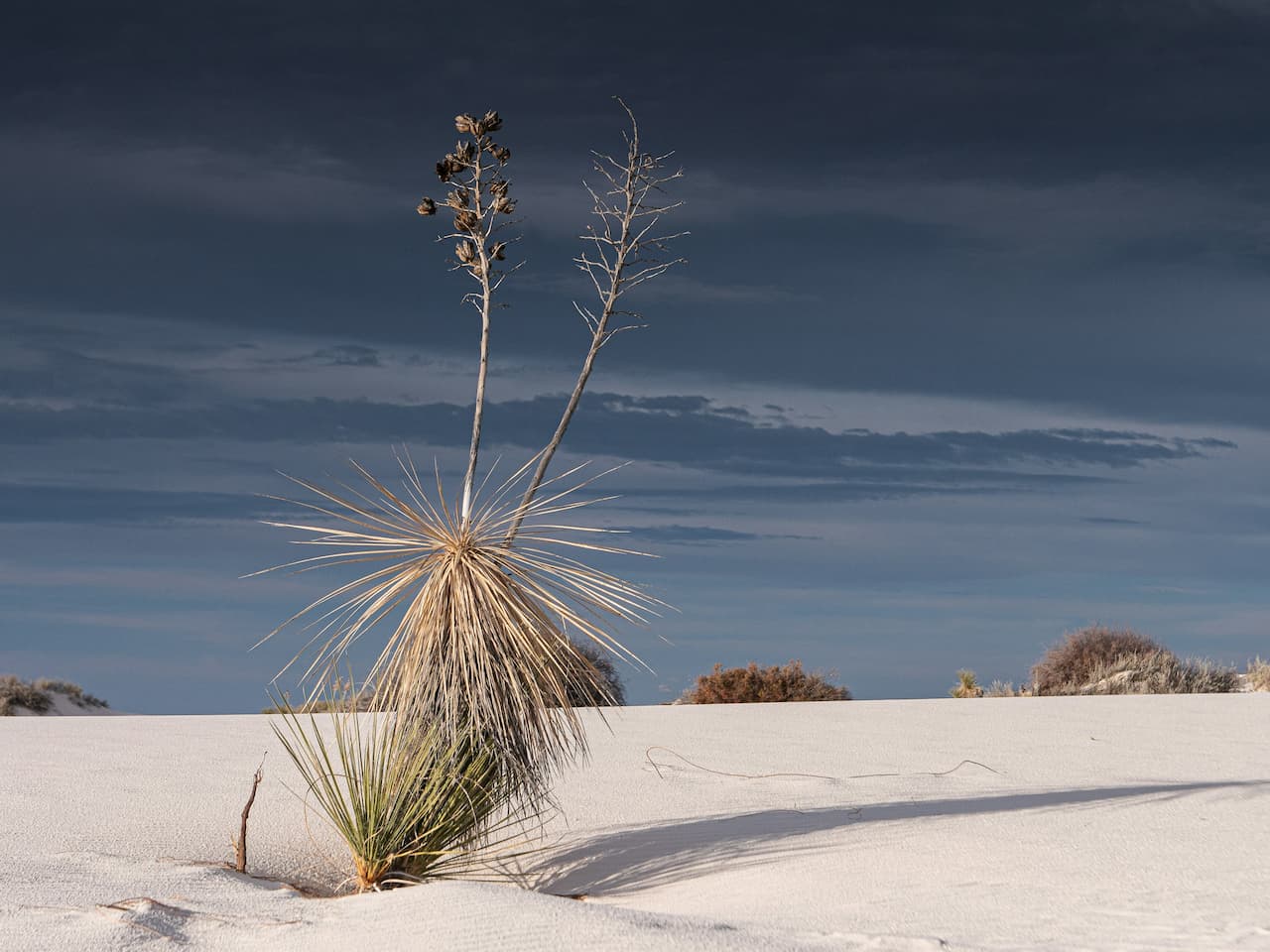
At a glance
The yucca is one of the most architecturally striking houseplants available in the UK and one of the most forgiving. Its sword-like leaves radiating from a stout, often multi-headed trunk give it a sculptural quality that few other indoor plants match, and its tolerance of neglect – specifically its ability to survive significant periods without water – makes it an excellent choice for busy households or less attentive plant owners. A well-positioned yucca in good light will grow steadily for decades, eventually becoming a substantial statement piece with genuine presence.
The most commonly sold indoor variety in the UK is Yucca elephantipes, sometimes labelled as Yucca guatemalensis – both are synonyms for the same plant, now correctly called Yucca gigantea. This is the spineless yucca, a softly-tipped variety safe around children and pets that brush against it, though the plant remains toxic if ingested. Getting the fundamentals right accounts for almost all successful yucca growing. Where yuccas fail indoors it is almost always for one of two reasons: they are placed in insufficient light, or they are watered too frequently.
Why light is the most important factor
The yucca originates from arid regions of the Americas where it grows in full sun, often in desert or semi-desert scrubland with minimal canopy cover. Its physiology is adapted to high light levels – its growth rate, root activity, water usage and ability to withstand overwatering all depend on adequate photosynthesis. In a UK context, a bright room away from a window is not the same as good light. Light intensity indoors falls dramatically within a metre or two of the window, and a yucca placed more than two metres from the nearest window is in significantly lower light than it needs.
The brightest position in the house – within a metre or two of a south or west-facing window – is where a yucca will perform best. Direct sun through glass is not a problem for an established yucca and is actively beneficial. East-facing positions provide morning sun and are acceptable. North-facing rooms should be avoided entirely.
The effect of insufficient light is not always dramatic in the short term. New leaves are smaller, colour becomes a paler yellow-green rather than deep blue-green, and new growth stretches toward the nearest light source. Simultaneously the roots become less active in low light, meaning water sits in the compost far longer than it would in a well-lit position, dramatically increasing root rot risk even if the watering schedule has not changed. This is the hidden mechanism behind many yucca deaths: the plant was moved to a lower-light position, the roots slowed, the compost stayed wet longer, and rot developed. Moving a struggling yucca to a brighter position is the single most effective intervention available – the improvement in colour and growth is visible within four to six weeks.
Watering – why less is always more
The yucca’s trunk stores water. The thick woody trunk contains substantial water reserves that sustain the plant through weeks of drought without visible stress. This is a literal structural adaptation to an environment where rainfall is infrequent and unpredictable. The correct approach is to water thoroughly, allowing water to drain freely from the bottom of the pot, then leave the compost to dry out completely before watering again. Not mostly dry. Completely dry. Poking a finger 3 to 4 centimetres into the compost is the simplest test – if any moisture is felt at that depth, wait longer.
In spring and summer, complete drying typically takes two to three weeks. In autumn and winter when growth slows and light levels drop, the same compost may take four to six weeks or more. Many growers water on a fixed schedule regardless of season and this is how winter overwatering develops. The frequency needs to follow the drying rate, not a calendar. Water thoroughly when the compost is completely dry, then tip away any water that collects in the saucer within an hour. Standing water in a saucer is absorbed back up through the drainage holes and keeps the bottom of the compost constantly wet – where root rot begins.
Hard tap water can cause brown leaf tips over time through fluoride and salt accumulation. If brown tipping is persistent and the plant is otherwise well-positioned, switching to rainwater or flushing the compost thoroughly every few months by watering very generously several times in succession helps to remove accumulated salts.
Compost, drainage and pot choice
Free drainage is as fundamental as the watering approach. Standard multipurpose composts retain too much moisture for a yucca. A cactus and succulent compost – either bought or made by mixing standard multipurpose with 30 to 50 percent perlite or coarse grit – provides the drainage the plant needs. The compost should feel gritty and drain almost immediately when water is added.
Terracotta pots are preferable to plastic or glazed ceramic for two reasons: terracotta is porous and allows moisture to evaporate through the walls, reducing how long the root zone stays wet after watering; and terracotta provides weight and ballast for a top-heavy plant. A mature yucca in a lightweight plastic pot will topple repeatedly. Pot size should be appropriate to the root ball – yuccas prefer a relatively tight pot. Move up only one size when repotting. Overpotting creates a large volume of compost with no active roots in it, which stays wet for extended periods and invites root rot. Drainage holes are non-negotiable – never pot a yucca into a container without them.
Seasonal care – UK conditions
Repotting, pruning and propagation
Yuccas need repotting infrequently – some go five or more years between repottings. The signs that repotting is needed are roots growing through the drainage holes, the plant becoming visibly unstable, or growth stalling despite adequate light and watering. Repot in spring only. Remove the plant, cut away any black or mushy roots with clean scissors, dust cut surfaces with cinnamon powder if rot is present, and allow to dry for a day before potting into fresh dry cactus compost one pot size up. Do not water for at least a week after repotting.
If an indoor yucca has become too tall, the trunk can be cut at the desired height with a clean sharp saw. Allow the cut surface to dry for a day. The remaining stump will typically produce multiple new shoots from just below the cut within eight to twelve weeks. The removed top section can be propagated: strip the lower leaves from the bottom 10 to 15 centimetres, allow the cut end to dry for two days, pot into dry cactus compost and do not water for two weeks. Place in bright warmth. Roots develop within four to six weeks. Offsets – small shoots at the base of the main trunk – can also be removed once they have several leaves of their own, allowed to callous for a day, and potted individually.
Common problems and diagnosis
Root rot is the most common cause of yucca death indoors. By the time the trunk itself feels soft at the base, the rot has progressed significantly. At that stage the plant can sometimes be saved by removing the top of the plant above the rot and propagating it. Whether the plant survives depends on how much healthy root tissue remains. Prevention is straightforward: free-draining compost, a pot with drainage holes, no standing water in saucers or cachepots, and allowing complete drying between waterings.
Indoor varieties compared
Growing yucca outdoors in the UK
Several yucca species are sufficiently hardy to grow outdoors in the UK year-round. The UK’s wet winters are more damaging than the cold – a plant that would survive a hard frost in dry conditions can succumb to root rot in persistently waterlogged clay soil. Choosing the right species, the right position and managing winter moisture are the keys to success.
Buying a healthy yucca
When buying a yucca, the trunk should feel firm and solid throughout its length – any soft sections indicate rot. Leaves should be deep blue-green rather than pale yellow-green, which indicates the plant has been in inadequate light. Check the undersides of leaves for the white cottony clusters of mealybugs and reject any plant showing infestation. Any darkening, softness or foul smell at the base of the trunk is a sign of root rot in progress.
Newly purchased yuccas often need a period of acclimatisation. Hold back on watering for the first two to three weeks to allow the root system to adjust, and give the plant a month before drawing conclusions. A well-managed yucca is a genuinely long-lived houseplant – plants purchased as small specimens can grow into substantial floor-to-ceiling individuals over ten to fifteen years. Planning the final position with the eventual size in mind from the start saves significant disruption later.
The two failure modes account for almost all yucca deaths: too little light and too much water. Fix either of these and a struggling yucca will almost always recover. A yucca in a bright position near a south-facing window, watered only when completely dry, in free-draining compost, will thrive for decades with minimal attention.
Share on socials: